

Signs, Symptoms, Age & What Canadian Women Need to Know
If you are in your 40s, building your career, raising a family, managing responsibilities — and suddenly your sleep, mood, or cycle feels different — you may be entering perimenopause.
Perimenopause is the natural hormonal transition before menopause. It can begin years before your periods stop completely — and for many women, the symptoms are subtle at first, then disruptive.
In Canada, there are an estimated 10 million women over age 40 currently in the menopausal transition, including perimenopause¹. This is not a fringe issue — it is a major public health stage affecting millions of Canadian women in their peak professional years.
What Is Perimenopause?
Perimenopause means “around menopause.”
Menopause is defined as 12 consecutive months without a menstrual period. Perimenopause is the transitional phase leading up to that point.
It is not a disease. It is a biologically programmed shift in ovarian function.
What Age Does Perimenopause Start?
- Most women begin perimenopause between 40–45
- It can begin as early as the late 30s
- The average age of menopause in Canada is 51 years²
- The transition typically lasts 2–8 years³
For high-performing women, this often overlaps with peak leadership, caregiving, and financial responsibility years — making symptom recognition critical.
What Is Happening to Your Hormones?
Contrary to popular belief, estrogen does not simply decline.
During perimenopause:
- Ovulation becomes inconsistent
- Progesterone declines first
- Estrogen fluctuates unpredictably
These fluctuations affect multiple systems:
- Thermoregulation (hot flashes)
- Neurotransmitters (mood, anxiety)
- Sleep
- Metabolism
- Cognitive processing
Research confirms that estrogen variability during the menopausal transition is associated with increased vulnerability to depressive symptoms and cognitive shifts⁴,⁵.
Common Perimenopause Symptoms
Symptoms vary widely — but these are the most frequently reported:
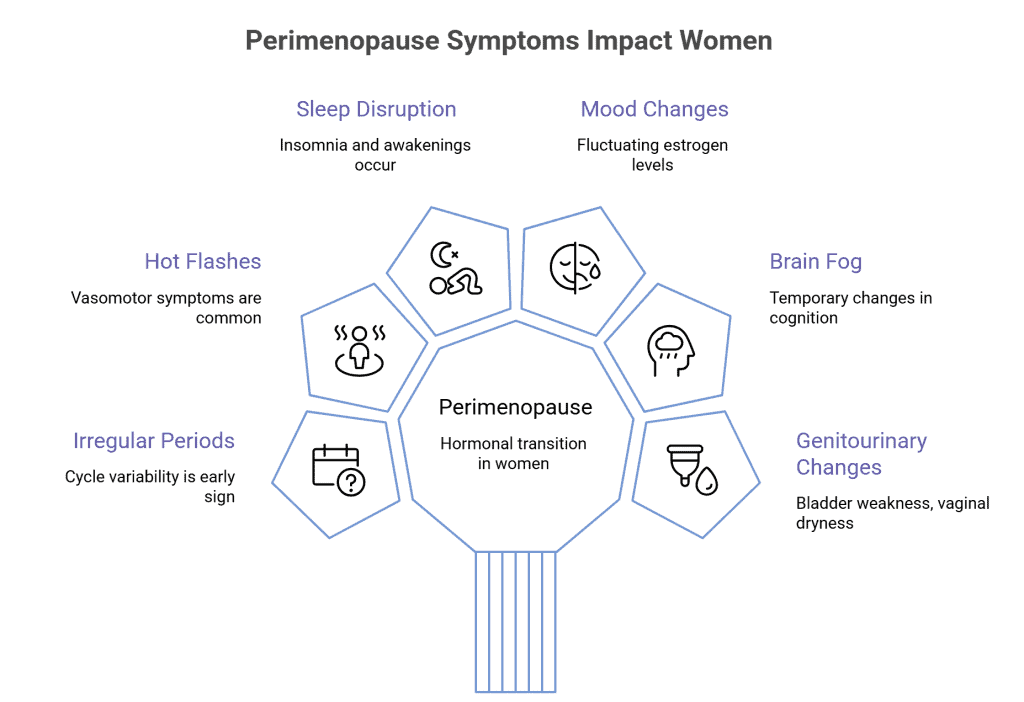
Canadian Context: Why This Matters
According to Statistics Canada, women aged 40–55 represent a substantial proportion of the Canadian workforce⁸.
Yet menopause-related symptoms are still under-discussed in clinical settings and workplaces. The Menopause Foundation of Canada has reported that menopause symptoms significantly affect workplace productivity and quality of life for Canadian women¹.
For professional women balancing leadership roles and caregiving responsibilities, untreated symptoms can impact performance, confidence, and overall wellbeing.
What Can Women Do?
Lifestyle Foundations
Evidence supports:
- Resistance training
- Adequate protein intake
- Blood sugar stability
- Sleep hygiene
- Stress reduction
These interventions improve metabolic resilience and symptom tolerance.

Drug and Supplement Options
Depending on symptoms and health history:
- Menopausal Hormone Therapy (MHT)
- Supplements to support hormones and neurotransmitter imbalances
- Non-hormonal pharmacologic options (e.g. SSRIs)
- Vaginal estrogen for urogenital symptoms
Treatment should always be individualized. In my practice as an ND, I have a wealth of experience in treating perimenopausal women. If you are looking for support, please connect with me via email at listabrizi@gmail.com or book a consult here.
Key Takeaway
Perimenopause is a normal biological transition — but unmanaged symptoms can significantly affect quality of life, especially for high-performing women in their 40s and early 50s.
Education and proactive care change outcomes. You can feel strong & vibrant again! Book a consult with me today
Simply Healthy, Simply Strong
References
- Canadian Institutes of Health Research. Menopause and women’s health in Canada. Government of Canada; 2023.
- Public Health Agency of Canada. Report on menopause in Canada. Ottawa; 2022.
- Harlow SD, et al. Executive summary of the Stages of Reproductive Aging Workshop +10 (STRAW+10). Menopause. 2012;19(4):387-395.
- Santoro N, et al. The menopausal transition and depression. J Clin Endocrinol Metab. 2015;100(5):1742-1749.
- Maki PM, Jaff NG. Cognitive changes during the menopausal transition. Climacteric. 2022;25(1):1-9.
- Freeman EW, et al. Hot flashes in the menopausal transition. Obstet Gynecol Clin North Am. 2018;45(4):709-722.
- Avis NE, et al. Duration of menopausal symptoms. JAMA Intern Med. 2015;175(4):531-539.
- Statistics Canada. Labour force characteristics by age and sex. 2023.