
If you’ve caught yourself thinking:
- “Why am I more reactive than I used to be?”
- “Why does everything feel louder?”
- “This doesn’t feel like me.”
You are not alone. And you are not imagining it.
Perimenopause is not simply a time of “low hormones.” It is a time of hormonal variability, and your brain is exquisitely sensitive to those fluctuations.
According to the Menopause Foundation of Canada, many women are unaware that anxiety, irritability, and mood changes are common during the menopausal transition —
despite the fact that the majority experience symptoms during this stage of life.
Let’s unpack what is actually happening — biologically, neurologically, and practically.
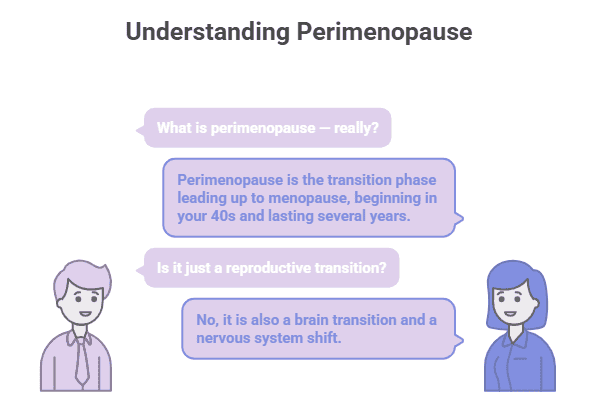
What Is Perimenopause — Really?
Perimenopause is the transition phase leading up to menopause. It can begin in your 40s (sometimes earlier) and may last several years before periods fully stop.
According to the Canadian Menopause Society, up to 80% of women experience menopausal symptoms — and these extend well beyond hot flashes.
This is not just a reproductive transition.
It is a brain transition.
Bottom line: Perimenopause is a nervous system shift, not just a menstrual one.
Why Moods Intensify: The Science Behind It
1. Hormone Fluctuations Affect the Brain
Estrogen doesn’t just regulate your cycle. It interacts with:
- Serotonin (mood stability)
- Dopamine (motivation)
- GABA (calm)
- The stress response system
A 2023 review in Pharmacological Reports highlights that fluctuations in estradiol during the menopausal transition — rather than simply low estrogen levels — are associated with increased vulnerability to depressive symptoms and mood disorders.
It is often the unpredictability — not just the decline — that drives symptoms.
Bottom line: Your emotional system is responding to hormonal turbulence
2. Sleep Disruption Amplifies Everything
Perimenopause commonly disrupts sleep through:
- Night sweats
- Early morning waking
- Fragmented sleep
- Increased stress reactivity
And even mild sleep deprivation increases:
- Irritability
- Anxiety
- Rumination
- Emotional sensitivity
If you’ve noticed that your tolerance is lower after a poor night’s sleep, that’s physiology — not personality.
If sleep has shifted significantly, this is something we assess carefully in structured menopause focused appointment. An appointment can be made here.
Bottom line: When sleep destabilizes, mood follows.
3. Blood Sugar Instability Becomes Less Forgiving
Midlife hormonal shifts can make your nervous system less resilient to:
- Skipping meals
- High-sugar meals
- Alcohol
- Excess caffeine
Stabilizing protein intake and blood sugar is one of the most overlooked tools for mood steadiness in midlife.
I often recommend starting with a protein-forward breakfast and balanced meals. This could be as simple as 2 hard boiled eggs, or adding a quality protein powder to your oatmeal.
Bottom line: Blood sugar swings can feel like emotional swings
4. Life Stage Stress Compounds Hormonal Sensitivity
Perimenopause often overlaps with:
- Peak career demands
- Caring for teens and aging parents
- Relationship strain
- Identity shifts
The nervous system does not neatly separate “hormonal” stress from “life” stress. They interact.
This is why some women who have never struggled with mood symptoms before suddenly feel:
- More anxious
- More irritable
- More tearful
- Less resilient
This does not mean something is “wrong” with you.
It means your system needs recalibration.
Bottom line: Hormones may be the spark — but stress can be the fuel.

Is This Normal — Or Something More?
It’s important to say clearly:
Mood changes during perimenopause are common.
Severe, persistent, or impairing symptoms are not something you should ignore.
If you’re experiencing:
- Ongoing low mood
- Escalating anxiety
- Panic symptoms
- Severe insomnia
- Functional decline
Please seek medical support promptly.
For many women, structured evaluation, lifestyle optimization, nervous system support, and — when appropriate — medical therapy can dramatically improve quality of life.
You do not have to “white knuckle” this season.
Practical Steps You Can Start This Week
1. Track Patterns (2–4 weeks)
- Sleep
- Mood
- Cycle changes
- Alcohol/caffeine
- Stress load
- Exercise
Patterns create clarity.
2. Stabilize the “Big Three”
Sleep protection
- Consistent wake time
- Morning daylight exposure
- Dim evenings
- Reduce alcohol
Protein-forward nutrition
- Prioritize breakfast protein
- Avoid long fasting gaps
- Balance carbohydrates
Nervous system regulation
- Daily walks
- Strength training
- Breathwork or restorative practices
Bottom line: You don’t need 20 interventions. You need the right ones.

Final Takeaway
If you feel more reactive, emotional, anxious, or unlike yourself in your 40s — there is a biological explanation.
This is not a personality flaw.
It is a transition.
And when approached with clarity, evidence, and intention, this season can become stabilizing — not destabilizing.
If you’re unsure whether what you’re experiencing is perimenopause, burnout, stress overload, or something deeper, I offer structured menopause consultations designed to map this out clearly and practically. As a naturopathic doctor focusing on midlife women’s health, I also integrate peer-reviewed research with individualized clinical care to support mood, sleep, and hormonal balance during perimenopause.
You deserve to feel steady again.
References
- Canadian Menopause Society. Menopause Hub. https://www.canadianmenopausesociety.org/
- Gordon JL, Sander B, Eisenlohr-Moul TA, Sykes Tottenham L. Mood sensitivity to estradiol predicts depressive symptoms in the menopause transition. Psychol Med. 2021 Jul;51(10):1733-1741. doi: 10.1017/S0033291720000483. Epub 2020 Mar 11. PMID: 32156321. https://pubmed.ncbi.nlm.nih.gov/32156321/
- Menopause Foundation of Canada. The Silence and the Stigma Report. https://menopausefoundationcanada.ca/
- Turek J, Gąsior Ł. Estrogen fluctuations during the menopausal transition are a risk factor for depressive disorders. Pharmacol Rep. 2023 Feb;75(1):32-43. doi: 10.1007/s43440-022-00444-2. Epub 2023 Jan 14. PMID: 36639604; PMCID: PMC9889489. https://pubmed.ncbi.nlm.nih.gov/36639604/