
You had it ready. You had practised it in the car.
And then the appointment ran short, and the moment passed, and you said thank you and you left, and you drove home with the same problem you arrived with.
Maybe it is that sex has started to hurt, and you have quietly stopped initiating. Maybe it is that you are on your third urinary tract infection this year after decades without one. Maybe it is that you now know where every washroom is, everywhere you go.
Here is what we want you to know before you read another word. These are not three separate problems. They are one problem with three faces, they have a clinical name, and unlike almost every other symptom of menopause, this one does not fade with time.
It progresses. Quietly, slowly, and predictably, for as long as it is left alone.
That is also the reason it is worth reading about now rather than next year. It is one of the most treatable things we see, and the barrier is almost never the treatment. It is the conversation.
In this article, you will learn what genitourinary syndrome of menopause actually is, why the urinary symptoms and the genital symptoms come from the same source, why this one behaves differently from hot flashes, what genuinely works across the full range of options, and what needs prompt assessment rather than patience.
October is Menopause Awareness Month, and World Menopause Day falls on the 18th. It seems a reasonable moment to say the thing you did not say.
One Cause, Three Faces
The clinical term is genitourinary syndrome of menopause, usually shortened to GSM. The older term was vaginal atrophy, which described less and sounded considerably worse.
The tissues of the vulva, vagina, urethra, and bladder are rich in estrogen receptors. Estrogen maintains their thickness, elasticity, blood flow, and natural lubrication. It also supports the acidic vaginal pH that keeps protective lactobacilli thriving and less welcome bacteria in check.
As estrogen falls through and after menopause, these tissues become thinner, drier, less elastic, and more fragile. Blood flow decreases. Vaginal pH rises. The protective microbial balance shifts.
That single change explains a symptom list that otherwise looks like three unrelated problems.
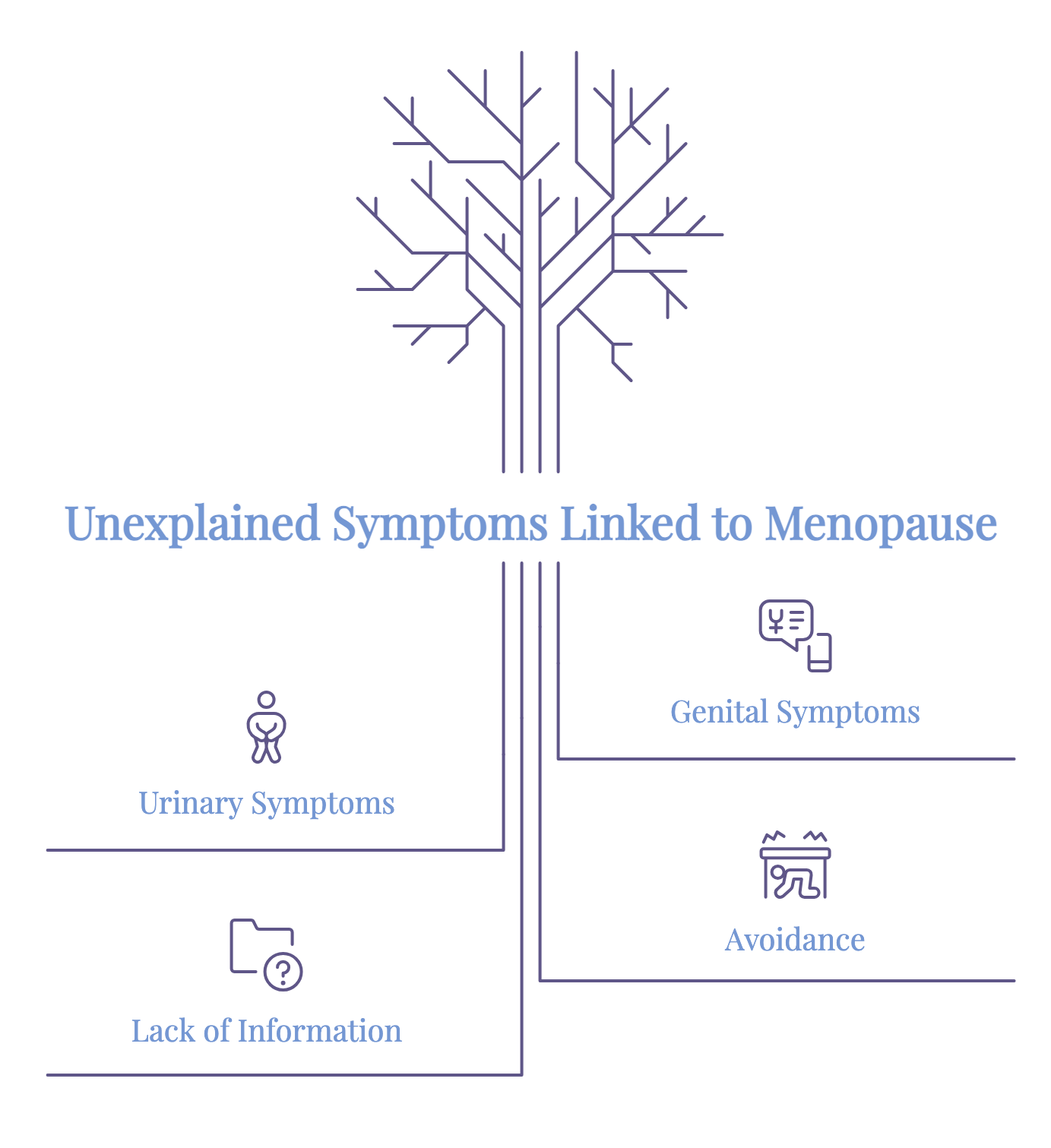
The genital face: dryness, burning, itching, pain or tearing with intercourse, reduced sensation or difficulty with arousal, light spotting after sex, and general irritation, sometimes with exercise or in certain clothing.
The urinary face: urgency, increased frequency including overnight, discomfort with urination, recurrent urinary tract infections, and leaking with coughing, laughing, or exercise.
The quiet face: the part that shows up as avoidance. Declining the trip, skipping the class, letting your partner draw their own conclusions.
A great many women experience the urinary symptoms first and never connect them to menopause at all, because nobody told them there was a connection.
Why This One Behaves Differently
Most menopausal symptoms follow an arc. Hot flashes and night sweats are often worst around the final period and gradually ease over the following years. Mood and sleep frequently stabilize as the body adapts to a new baseline.
GSM does not follow that arc.
Because it results from an ongoing absence of estrogen in the tissue rather than from hormonal fluctuation, it tends to be progressive. Without intervention, symptoms in most women stay the same or slowly worsen over time.
This matters because “give it time” is common advice and it is the wrong advice here. Waiting means years of avoidable discomfort, and tissue changes respond better to treatment earlier than later.
Estimates vary, but a substantial proportion of postmenopausal women experience GSM symptoms and only a minority ever raise them with a healthcare provider. The gap between how common this is and how often it is treated is one of the widest in women’s health.
Why Women Do Not Mention It
There is no shortage of reasons, and none of them are unreasonable.
It feels private in a way that hot flashes do not. There is an assumption that discomfort after menopause is simply expected, so raising it feels like complaining about the weather. Appointments are short, and this is not something you bring up in the final two minutes. Some women worry it signals a loss of desirability, or a relationship problem, rather than a tissue change. Others raised it once, were told to try lubricant, and reasonably concluded that was the extent of what was available.
Every one of those paths leads to the same place, which is women managing alone something that has genuinely effective treatment.
If it helps: your practitioner has heard this many times. It is a physiological change in a tissue, in the same category as dry eyes or thinning skin. It takes one sentence to name.
You can borrow one. “I am having vaginal dryness and urinary symptoms and I would like to talk about treatment options.” That is the whole thing.
What Actually Works
There is a real spectrum here, and most women do best with a combination rather than a single product.
- Vaginal moisturizers. Used regularly, typically two or three times a week rather than only around intimacy. These are absorbed by the tissue and improve baseline comfort. They are frequently confused with lubricants and they do a different job.
- Lubricants. Used at the time of intercourse for immediate comfort. Water based and silicone based options both exist. Avoid products with glycerin, strong fragrance, warming agents, or high osmolality, as these tend to irritate already sensitive tissue.
- Local vaginal estrogen. This is the most effective treatment for GSM and it deserves to be understood rather than feared. Delivered as a cream, tablet, or ring, it acts directly on the tissue with minimal absorption into the bloodstream, which makes it a different proposition from systemic hormone therapy. Many women who are not candidates for systemic treatment can still use it. It restores tissue thickness, elasticity, lubrication, and pH, and it has good evidence for reducing recurrent urinary tract infections. Improvement typically takes several weeks of consistent use, and benefits are maintained only while you continue. Suitability depends on your individual history, including any history of hormone sensitive cancer, so this is a conversation with your provider rather than a decision to make from an article.
- Systemic menopausal hormone therapy. For women with significant symptoms elsewhere, systemic therapy may address several things at once. It does not always fully resolve genitourinary symptoms on its own, and local treatment is often added alongside it. Our article on whether menopausal hormone therapy is safe works through the evidence, and our page on menopausal hormone therapy in Burlington explains how we approach the conversation.
- Non hormonal prescription options. These exist and may suit women who prefer or require an alternative. Worth asking about specifically.
- Pelvic floor physiotherapy. Genuinely underrated. It addresses the muscular component of painful intercourse and the urinary leaking that often travels alongside GSM, and it frequently makes the difference when tissue treatment alone has not been enough.
- Regular sexual activity or gentle stimulation. Maintains blood flow and supports elasticity. Comfort comes first, and this is a supporting measure rather than a treatment on its own.
What We Assess Before Reaching for Supplements
There is a market in products promising to reverse this naturally. Almost none of them can do what they suggest, and natural does not automatically mean risk free.
No oral supplement reliably restores tissue that has thinned because of estrogen loss. If a product implies otherwise, that is a reason for scepticism rather than hope.
What we do want to know before building a plan:
- Whether the urinary symptoms are GSM, infection, or both. Recurrent UTIs need proper diagnosis, not assumption.
- Your full history, including any hormone sensitive cancer, which shapes what is appropriate
- Whether pelvic floor dysfunction is part of the picture, because it changes the plan considerably
- Whether there is pain with a muscular rather than tissue origin
- What you have already tried, and how it was used, because moisturizers used as lubricants are a very common near miss
Local estrogen is highly effective and there is no benefit in avoiding it on principle. Naturopathic care works alongside conventional treatment here rather than in place of it, and part of the value we add is the referral, the wider hormonal context, and the parts of the picture that get missed. You can read more about our naturopathic services in Burlington.
Red Flags: Please Do Not Wait on These
Book with your physician promptly if you have:
- Any vaginal bleeding after twelve consecutive months without a period
- Bleeding after intercourse
- A new lump, sore, ulcer, or persistent skin change on the vulva
- Persistent pelvic pain
- Fever, back pain, or blood in your urine alongside urinary symptoms
- Symptoms that continue despite treatment
Postmenopausal bleeding is usually caused by something benign. It always needs to be investigated.
The Bottom Line
Vaginal dryness, painful sex, and recurring urinary tract infections are not three problems. They are one tissue change with three faces, and it affects a very large proportion of women after menopause.
Unlike hot flashes, this one does not resolve with time. It progresses when it is left alone, and it responds well when it is not. Treatment runs from moisturizers through local estrogen and pelvic floor physiotherapy, and most women improve substantially.
The obstacle is almost never the treatment. It is the sentence.
You are allowed to want comfort, intimacy, and a life that is not organized around the location of the nearest washroom. Good health creates opportunity, and that includes the parts of your life nobody puts in a brochure.
If this is something you have been carrying quietly, we would like to help. Book a menopause support consultation in Burlington.
Frequently Asked Questions
Does vaginal dryness from menopause go away on its own?
No. Unlike hot flashes, which often ease over time, genitourinary syndrome of menopause results from an ongoing lack of estrogen in the tissue and tends to be progressive. Symptoms typically persist or gradually worsen without treatment, which is why addressing it earlier produces better results than waiting to see whether it settles.
Is vaginal estrogen safe?
Local vaginal estrogen delivers a low dose directly to the tissue with minimal absorption into the bloodstream, which makes it a different proposition from systemic hormone therapy. It is widely considered appropriate for many women, including some who cannot use systemic treatment. Suitability depends on your individual medical history, particularly any history of hormone sensitive cancer, so please discuss it with your healthcare provider rather than deciding from an article.
Why am I getting urinary tract infections after menopause when I never used to?
Falling estrogen raises vaginal pH and reduces the protective lactobacilli that normally limit the growth of other bacteria, while urethral and bladder tissue also thins. Together these changes make recurrent urinary tract infections considerably more common after menopause. Local vaginal estrogen has good evidence for reducing recurrence, and recurrent infections should always be properly diagnosed rather than assumed.
Looking for menopause care that covers the whole picture?
Explore our perimenopause and menopause support for women in Burlington, Oakville, Waterdown, and across Halton. This article is for educational purposes and is not a substitute for individualized medical advice. Please consult a qualified healthcare provider about your specific situation.