
It is 3:40 in the afternoon and you are standing at the kitchen counter eating crackers out of the box.
You are not hungry in a way you can explain. You had lunch. A good lunch, actually, a big salad, the kind you would describe to someone else as healthy. And yet here you are, three hours later, unable to think clearly and looking for something, anything, with a crunch.
You have been eating well for years. Vegetables, not much processed food, careful portions. And still: softer than you were, slower to recover from a workout, hungry ninety minutes after breakfast, and quietly convinced you must be doing something wrong.
Here is what we want you to know before you read another word. For most women in perimenopause, the problem is not the total amount of food. It is the amount of one specific nutrient, and just as importantly, when in the day you are eating it.
There are two separate protein problems, and almost every woman we see has the second one even when she does not have the first.
The first is total intake. The second is distribution. You can hit a perfectly respectable daily total and still waste two of your three opportunities, because of a physiological change that happens in your 40s and that nobody tells you about.
In this article, you will learn why your requirements go up rather than down in midlife, what the real numbers are, what 30 grams actually looks like on a plate, why breakfast is where most women lose the most ground, and the mistakes we see most often.
Why Your Requirements Went Up, Not Down
Two things happen in midlife that raise the bar, and they compound each other.
Anabolic resistance. As we age, muscle tissue becomes less responsive to the protein we eat. A serving that would have triggered a strong muscle building signal at 25 produces a weaker one at 50. You need a larger amount at a single sitting to get the same effect. This is well documented and it is the central reason older adults need more protein rather than less.
Falling estrogen. Estrogen plays a direct role in maintaining muscle mass and in repairing muscle after exercise. As it declines through perimenopause, the rate of muscle loss accelerates. Women can lose a meaningful proportion of lean mass across the transition, often without noticing, because the scale barely moves while muscle is quietly replaced by fat.
Put together, the intake that maintained you comfortably for two decades is now insufficient to hold ground.
This is a large part of why weight changes in this decade feel so unresponsive to effort, as we cover in why your metabolism changes in midlife.

Two Problems Wearing the Same Apron
The total intake problem. You are simply eating less protein than you need across the day. Common in women who eat mostly plants without planning for it, who are eating lightly to manage weight, or whose appetite has dropped.
The distribution problem. Your daily total is fine. Almost all of it arrives at dinner. Breakfast was coffee and toast, lunch was a salad with a scattering of nuts, and dinner was 45 grams of chicken protein in one sitting.
Because of anabolic resistance, your body cannot make good use of a very large single dose. Two of your three chances to trigger muscle protein synthesis were spent on servings too small to send the signal.
This second one is the one to check first. It is far more common, it is invisible on a daily total, and it is the easier of the two to fix.
The Numbers, Practically
Official minimum recommendations sit around 0.8 grams of protein per kilogram of body weight daily. That figure is a floor designed to prevent deficiency. It was never intended as an optimum for preserving muscle in a woman going through hormonal change.
Current research on midlife and older adults consistently supports higher intake. A practical working range is roughly 1.2 to 1.6 grams per kilogram of body weight per day, with the upper end more relevant if you train regularly or are trying to lose fat while holding onto muscle.
For a woman weighing 70 kilograms, that is roughly 85 to 110 grams daily.
For distribution, aim for 25 to 35 grams per meal, three times a day.
Most women we see are getting around 10 grams at breakfast, 15 at lunch, and 40 at dinner. The total looks passable on paper. In practice, two thirds of the day was wasted.
One important note: if you have kidney disease or reduced kidney function, protein targets must be individualized with your healthcare provider. Higher intakes are not appropriate for everyone.
What 30 Grams Actually Looks Like
This is where good intentions usually fall apart, because 30 grams is more food than most people picture.
Approximate protein content:
- Chicken breast, 100g cooked: 30g
- Lean beef, 100g cooked: 30g
- Salmon, 100g cooked: 25g
- Cottage cheese, 1 cup: 25g
- Greek yogurt, 175g: 17g
- Firm tofu, 150g: 17g
- Tempeh, 100g: 19g
- Cooked lentils, 1 cup: 18g
- Canned chickpeas, 1 cup: 15g
- Two large eggs: 12g
- Protein powder, one scoop: 20 to 25g
- Almonds, quarter cup: 7g
Breakfast that actually gets there:
- Greek yogurt with berries plus two eggs
- Two eggs plus cottage cheese on toast
- A smoothie with protein powder, milk or fortified soy, and frozen fruit
Lunch that actually gets there:
- A large salad with 120g of chicken and a scoop of chickpeas
- Last night’s dinner protein with grains and vegetables
- A tofu and lentil bowl with tahini
If you eat plant based, these targets are entirely achievable and they require deliberate planning. Portions need to be larger, variety across the day matters for the full amino acid profile, and soy foods, lentils, and tempeh do most of the heavy lifting. Iron and B12 also warrant monitoring.
For meal ideas built around whole foods, our Nourish section is a reasonable place to start.
Why September Is the Month to Fix This
The autumn reset is genuinely useful here, and not for motivational reasons.
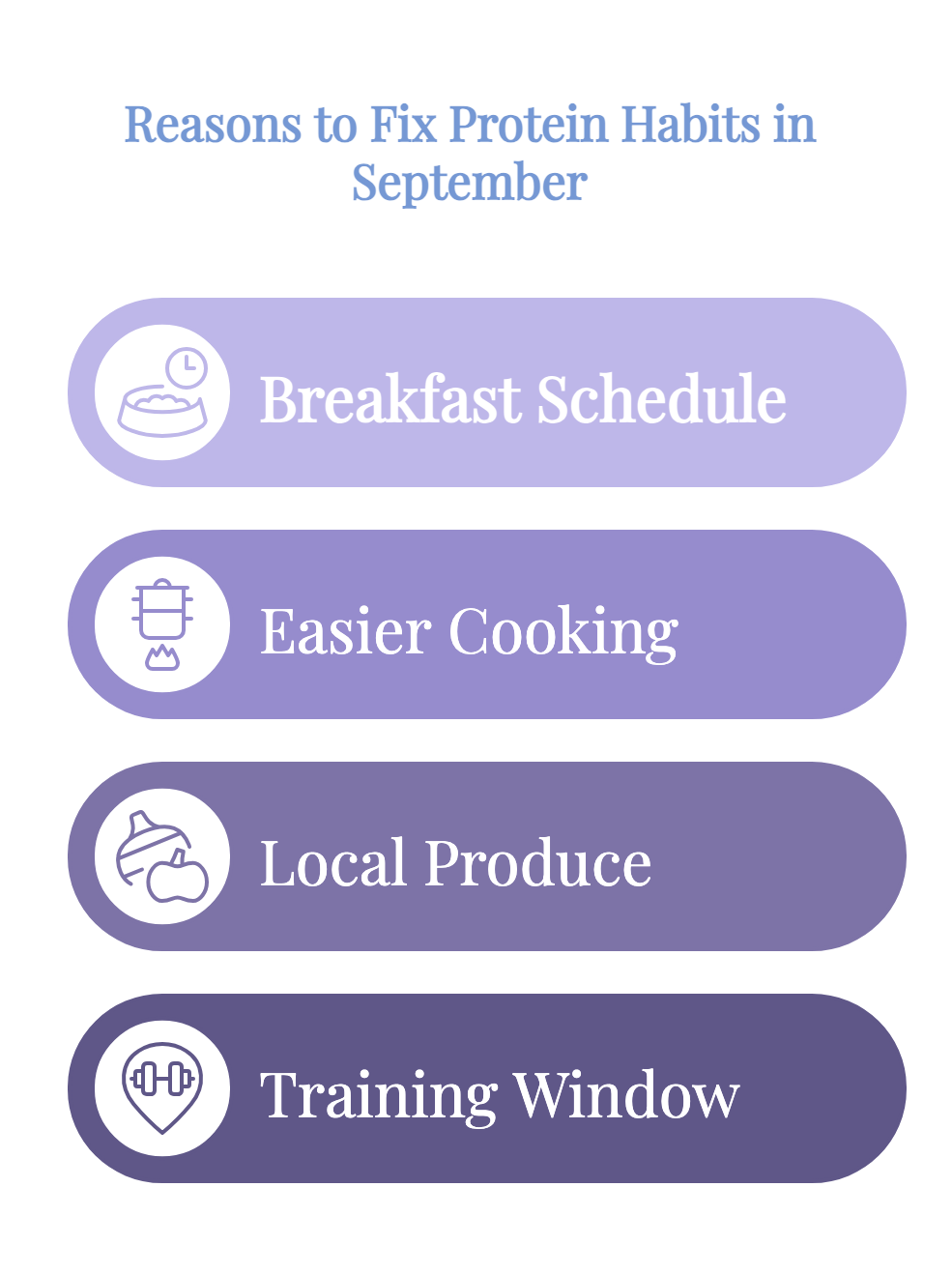
Breakfast returns to the schedule. Summer mornings dissolve. September mornings have a shape again, and a shape is exactly what a protein habit needs. If you are packing lunches for someone else anyway, you are already standing in the right room.
Cooking gets easier. Nobody wants a roast in July. Batch cooking, soups, stews, and roasted trays all become appealing again, and all of them make protein at lunch considerably simpler.
Local produce is at its best. Late September through October is peak season across Halton, which makes the vegetables side of the plate almost effortless while you focus on the protein side.
Your training window is opening. Cooler weather makes strength work more appealing, and protein without resistance training does not build anything.
The Mistakes We See Most
- Coffee only until 11 a.m. This is the single biggest gap. You went twelve hours overnight without protein and then extended it by another four.
- Treating a salad as a meal. Greens with a sprinkle of nuts is a side dish. Add a substantial protein source and it becomes lunch.
- Relying on protein bars. Many contain less protein than the front of the package implies and a great deal of sugar alcohol. Fine occasionally, poor as a foundation.
- Adding protein without adding training. Protein is the raw material. Resistance training is the reason your body has to use it. Without the stimulus, extra protein builds nothing, which is exactly why lifting weights changes everything in your 40s.
- Cutting calories hard. When intake drops sharply, the body draws on muscle as well as fat. Protein becomes more important during fat loss, not less.
- Assuming muscle is cosmetic. It is the largest site of glucose disposal in your body, it drives your metabolic rate, and the mechanical pull of muscle on bone is one of the primary signals maintaining bone density, which is why your 40s are the most important decade for your bones.
When to Get Personalized Guidance
Please speak with a healthcare provider before making significant dietary changes if you have:
- Any kidney condition or reduced kidney function
- A history of disordered eating
- Diabetes requiring medication adjustment
- Unexplained weight loss, difficulty swallowing, or persistently poor appetite
- Nutrition targets are a starting framework, not a prescription that fits every individual.
The Bottom Line
Protein requirements rise in midlife because muscle becomes less responsive to it and estrogen no longer provides the protection it once did.
Roughly 1.2 to 1.6 grams per kilogram of body weight per day, spread as 25 to 35 grams at each of three meals rather than concentrated at dinner. Breakfast is where nearly every woman loses the most ground, and it is the easiest thing on this list to change.
Protein alone will not build anything. Paired with resistance training, it protects the lean mass that supports your metabolism, your bones, your blood sugar, and your ability to get off the floor at 80.
This is one of the highest return changes available to you in this decade, and unlike a great deal of what happens in perimenopause, it is entirely within your control.
If you would like a plan built around your actual life rather than a generic number, book a nutrition consultation in Burlington. You can also read more about how we approach nutrition counselling.
Frequently Asked Questions
How much protein should a woman over 40 eat per day?
Research on midlife and older adults generally supports 1.2 to 1.6 grams of protein per kilogram of body weight daily, which is higher than the standard minimum recommendation of 0.8 grams per kilogram. For a woman weighing 70 kilograms that works out to roughly 85 to 110 grams per day. Individual needs vary, and anyone with kidney disease should have targets set with their healthcare provider.
Is it better to eat protein at every meal or just at dinner?
Spreading it across meals is considerably more effective. Because muscle becomes less responsive to protein with age, a meaningful amount is needed at each sitting to trigger muscle protein synthesis. Roughly 25 to 35 grams at breakfast, lunch, and dinner produces better results than the same daily total concentrated in one evening meal.
Does protein help with perimenopause weight gain?
Indirectly, yes. Adequate protein supports the preservation of muscle mass, which maintains metabolic rate and improves insulin sensitivity, and protein is the most satiating of the macronutrients, which helps regulate appetite. It works best combined with resistance training rather than on its own, and it is one part of a picture that also includes sleep, stress, and hormonal change.
Looking for practical nutrition guidance through perimenopause?
Explore our perimenopause and menopause support for women in Burlington, Oakville, Waterdown, and across Halton. This article is for educational purposes and is not a substitute for individualized medical advice. Please consult a qualified healthcare provider about your specific situation.