You were in bed by ten. You did not lie awake. As far as you know, you slept.
And you woke at six feeling like you had been hit by something.
There is a headache behind your eyes most mornings that clears by about ten. You are foggy until the second coffee. You hit a wall in the mid afternoon that feels almost chemical. Your blood pressure has crept up at your last two appointments and nobody can explain why. You are short tempered in a way that does not match your circumstances and you have started apologizing for it.
We have written before about the two most common causes of disrupted sleep in perimenopause: the night sweat that wakes you hot, and the 3 a.m. wakeup that wakes you wired. Sorting those two apart resolves a great deal.
Here is what we want you to know before you read another word. There is a third possibility, and it is the one that explains the women who did everything right and are still exhausted.
You cooled the room. You bought the dehumidifier. You moved the wine earlier, ate protein at dinner, got morning light, fixed your iron, checked your thyroid. Some of it helped a little. None of it worked properly.
If that is you, the question is no longer how many hours you are sleeping. It is what is happening to your breathing while you sleep.
In this article, you will learn why sleep apnea risk rises sharply in women through the menopausal transition, why it looks nearly identical to perimenopause and is therefore missed, which signs are worth acting on, why it matters well beyond feeling tired, and what to ask for.
Why This Rises Sharply After 40 in Women
Obstructive sleep apnea occurs when the muscles of the upper airway relax during sleep and the airway narrows or closes. Breathing pauses. Oxygen dips. The brain triggers a brief arousal to restore breathing, usually too brief to remember.
This can happen dozens of times an hour, all night, with no conscious awareness of any of it. You are not lying awake. You are surfacing, over and over, and never reaching the deep stages where recovery actually happens.
Before menopause, women are relatively protected compared with men. That protection erodes, for reasons that are specific and physiological.
Progesterone stimulates the muscles that hold the upper airway open and supports respiratory drive. Progesterone declines early in perimenopause, frequently before estrogen does.
Estrogen influences fat distribution and airway tissue. As it falls, fat tends to redistribute toward the trunk and neck, and soft tissue in the airway changes.
Body composition shifts. Loss of lean mass and gain of central fat, both common through this transition, independently increase risk. This is one more reason the metabolic changes of this decade are worth addressing rather than accepting, as we cover in why your metabolism changes in midlife.
Research consistently shows prevalence in women rises substantially after menopause, moving much closer to the rates seen in men. The transition itself is a genuine risk factor, and very few women are told this.

Why It Gets Missed in Women Specifically
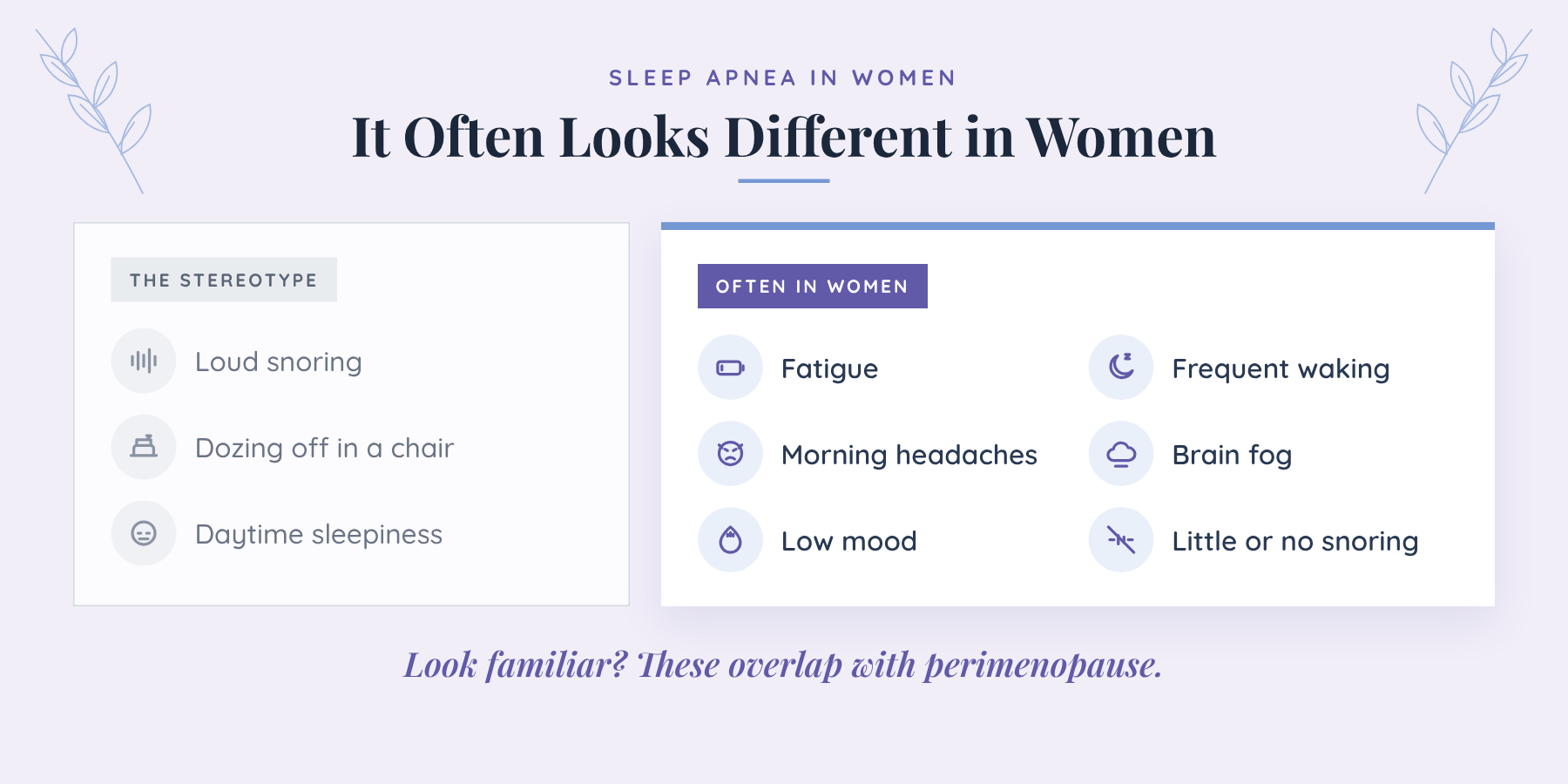
The mental image of sleep apnea is a heavyset middle aged man who snores like a chainsaw and falls asleep in his armchair after dinner. That picture is doing real harm.
Women more often present with:
- Fatigue rather than obvious daytime sleepiness
- Insomnia, including trouble falling asleep or frequent waking
- Morning headaches
- Depression, anxiety, or irritability
- Brain fog and poor concentration
- Getting up to urinate overnight
- Light snoring, or none that anyone has reported
Read that list again. It is a perimenopause symptom list. That is the entire problem.
Three further things compound it.
Reporting. Snoring is usually noticed by a partner. Women who sleep alone, or whose partner sleeps deeply, may have no idea. Women are also less likely to volunteer that they snore.
Screening tools. Some widely used questionnaires were validated largely in male populations and weight risk factors accordingly, which can underestimate risk in women.
Attribution. When a woman of 48 reports fatigue, poor sleep, low mood, and weight gain, the working assumption is hormonal. It is a reasonable assumption. It is not always the complete one.
Signs Worth Acting On
Consider asking for a sleep assessment if several of these apply:
- You wake unrefreshed regardless of how many hours you slept
- You have frequent morning headaches that clear through the morning
- Someone has told you that you snore, gasp, or stop breathing
- You wake with a dry mouth or sore throat
- You get up to urinate more than once a night
- Your blood pressure is rising or difficult to control
- Your neck circumference has increased
- You grind your teeth at night
- There is a family history of sleep apnea
- You have already addressed sleep hygiene, iron, thyroid, stress, and possibly hormone therapy, and you are still exhausted
That last point deserves emphasis. If you have worked through the obvious causes carefully and the fatigue has not moved, that unresolved gap is information rather than a personal failure.
Why It Is Worth Finding
Untreated sleep apnea is not simply a matter of feeling tired. The repeated oxygen dips and arousals place ongoing strain on the cardiovascular and metabolic systems, night after night, for years.
Established associations include:
- Hypertension, including blood pressure that resists treatment. Midlife is already a period of rising cardiovascular risk, as we explain in why blood pressure increases in midlife, and this compounds an existing trend.
- Insulin resistance and type 2 diabetes
- Increased cardiovascular risk, including stroke and atrial fibrillation
- Weight gain, through effects on the hormones regulating appetite, creating a loop in which weight gain worsens apnea and apnea promotes weight gain
- Mood disorders and cognitive symptoms
The reason to pursue this is not only tomorrow morning. It is that this is a modifiable contributor to the risks that matter most across the second half of your life.
Why an Ontario Autumn Brings This to the Surface
The seasonal shift does not cause sleep apnea. It removes the cover it was hiding behind.
The clocks change. The end of daylight saving time in early November disrupts circadian rhythm for one to two weeks. Sleep that was borderline becomes conspicuously poor, which is often when women finally go looking for answers.
Mornings are dark. Waking in darkness makes unrefreshing sleep considerably harder to push through. In July you got up with the sun and felt reasonably functional. In late October, the same night’s sleep feels much worse.
Seasonal weight gain is common. Activity drops, appetite changes, and even modest gain around the neck and trunk can worsen airway collapse.
Nasal congestion increases. Autumn allergens, dry indoor heat, and respiratory infections all narrow the nasal airway and worsen obstructive breathing.
Alcohol intake often rises through the darker months. Alcohol relaxes airway muscles and directly worsens apnea severity on the nights you drink.
What We Assess Before Reaching for Supplements
We should be very clear about this. Naturopathic care does not treat sleep apnea. Diagnosis requires a sleep study, and treatment sits with your family physician and a sleep specialist. Any product marketed as a natural alternative to proper diagnosis deserves real scepticism, and no amount of magnesium will treat a closing airway.
What we can do is make sure the question gets asked and that everything sitting alongside it is addressed.
Before building a sleep plan, we want to know:
- Whether sleep disordered breathing has been screened for at all, and to raise it with you and support a referral if the history suggests it
- Ferritin and full iron status, since low iron drives restless legs and fragmented sleep
- Thyroid function assessed properly, because it mimics both insomnia and fatigue
- Vitamin D and B12, particularly heading into winter
- Blood sugar and insulin markers, which govern the overnight dip
- The vasomotor and cortisol components, because most women have more than one thing happening at once
We use functional lab testing purposefully rather than exhaustively. Where the picture is hormonal, nutritional, or metabolic, there is a great deal we can do. Where it is not, the most useful thing we can do is help you get to the right assessment rather than spend another year layering supplements onto an unanswered question. You can read more about our naturopathic services in Burlington.
If sleep apnea is confirmed, treatment options include CPAP therapy, oral appliances made by a dentist for mild to moderate cases, positional therapy, weight management where relevant, and occasionally surgical assessment. Supporting body composition through nutrition and resistance training addresses one genuinely modifiable risk factor, and that part sits well within our scope.
When to Seek Medical Attention
Speak with your physician promptly if you experience:
- Witnessed pauses in breathing during sleep
- Falling asleep while driving or at your desk
- Waking gasping or choking
- Chest pain, palpitations, or shortness of breath at night
- Severe morning headaches
- Blood pressure that will not come down despite treatment
Sleep apnea cannot be diagnosed from symptoms alone. It requires a sleep study, at home or in a laboratory, and home based testing has made access considerably easier than it once was.
The Bottom Line
If you are getting enough hours and waking exhausted, hormones may not be the whole story.
Sleep apnea rises sharply in women through and after the menopausal transition, driven by falling progesterone, changing estrogen, and shifting body composition. It is routinely missed because women present with fatigue, insomnia, morning headache, and low mood rather than the loud snoring stereotype, and because those symptoms look exactly like perimenopause.
It is worth finding, because untreated it feeds into high blood pressure, insulin resistance, and cardiovascular risk across the decades when those matter most.
Persistent exhaustion is information. It deserves an explanation rather than an assumption, and you are not meant to spend another winter running on empty. Sleep sits underneath your energy, your mood, your metabolism, and your capacity to enjoy the life you have built.
If you have been tired for a long time without a clear answer, we would like to help. Book a consultation in Burlington and look at the whole picture.
Frequently Asked Questions
Can menopause cause sleep apnea?
Menopause is a recognized risk factor. Progesterone supports the muscles that keep the upper airway open and stimulates respiratory drive, and it declines during perimenopause. Falling estrogen also contributes to changes in fat distribution and airway tissue. Research consistently shows that prevalence rises substantially in women after menopause, approaching rates seen in men.
What are the signs of sleep apnea in women?
Women often present differently from the classic picture. Common signs include waking unrefreshed despite adequate hours, morning headaches, insomnia, brain fog, low mood, dry mouth on waking, waking to urinate more than once overnight, and rising blood pressure. Snoring may be light or entirely absent, which is a major reason the condition goes undetected in women.
How is sleep apnea diagnosed?
It requires a sleep study, conducted either at home or in a sleep laboratory, which measures breathing, oxygen levels, and sleep architecture overnight. It cannot be diagnosed from symptoms alone or from a questionnaire. Your family physician can arrange the referral, and home based testing has made access considerably easier than in the past.
Looking for help with sleep, energy, and hormones through midlife?
Explore our perimenopause and menopause support for women in Burlington, Oakville, Waterdown, and across Halton. This article is for educational purposes and is not a substitute for individualized medical advice. Please consult a qualified healthcare provider about your specific situation.