
You put your feet on the floor and it hurts.
Not badly. Not enough to mention to anyone. Just enough that you take the first ten steps carefully, like someone considerably older than you are, and by the time you reach the kitchen it has mostly worn off.
Your hands feel thick and stiff until about nine. Your hips ache after a long meeting. Your shoulder has developed a catch you cannot trace to any injury, and you have quietly stopped reaching for the top shelf.
You did not fall. You did not change anything. You are 47.
Here is what we want you to know before you read another word. Joint pain in midlife has two very different explanations that feel almost identical in the first ten steps of the morning, and the response to each is close to opposite.
One is hormonal, and the right answer is to move more, not less. The other is inflammatory or structural, and it needs a diagnosis rather than a walking programme.
Most women assume the first without checking for the second, or assume it is simply age and start doing less. Doing less is the single most reliable way to make either version worse.
In this article, you will learn what estrogen actually does for your joints, how to recognize the hormonal pattern, the shoulder problem almost nobody warns women about, why a Southern Ontario autumn amplifies all of it, and the symptoms that mean it is time to be assessed.
What Estrogen Was Doing for Your Joints
Estrogen receptors are present throughout your musculoskeletal system. In cartilage, in tendons and ligaments, in the synovial lining of joints, in bone, and in muscle.
Estrogen does several things at once. It has an anti inflammatory effect, helping regulate inflammatory signalling. It supports the production and quality of collagen, the structural protein in tendons, ligaments, cartilage, and skin. It influences fluid content and lubrication within the joint. It also plays a role in how pain is processed centrally, meaning it affects both the inflammation and your perception of it.
When estrogen declines, and particularly when it swings unpredictably as it does in perimenopause, all of that shifts together.
The same collagen change is why skin becomes drier and thinner during this period, which we cover in why your skin is changing in midlife. Connective tissue is connective tissue, whether it is in your face or your knee.
Two Kinds of Ache Wearing the Same Slippers
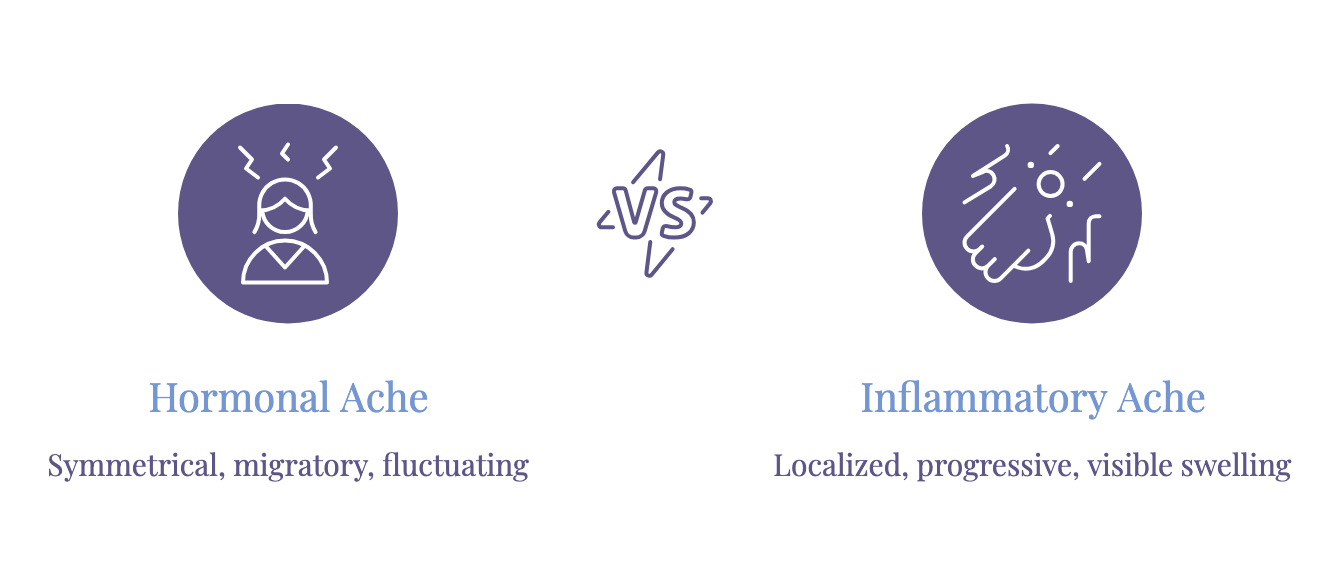
The hormonal pattern looks like this:
- Symmetrical. Both hands, both knees, both hips, rather than one isolated joint
- Morning stiffness that eases within about thirty minutes of moving
- Small joints involved, particularly hands, wrists, and feet, alongside larger ones
- Migratory. The location seems to shift from month to month
- Fluctuating with your cycle, often worse in the days before a period
- Aching and stiffness rather than sharp pain, without redness or heat
- Worse after sitting, driving, or sleeping, better once you get going
The inflammatory or structural pattern looks different:
- Visible swelling, warmth, or redness in a joint
- Morning stiffness lasting longer than an hour
- Localized to one or two joints and worse with use rather than after rest, which points more toward osteoarthritis
- Steadily progressive rather than fluctuating
- Accompanied by fever, night sweats, rash, or unexplained weight loss
Both can be present. A woman can have hormonal aching and early osteoarthritis in one knee at the same time. The point of sorting them is to know which one needs a diagnosis and which one needs a barbell.
The Shoulder Problem Nobody Warns You About
Frozen shoulder, clinically called adhesive capsulitis, deserves its own paragraph because the association is striking and almost no woman has been told about it.
It occurs disproportionately in women between roughly 40 and 60, which maps directly onto the menopausal transition. Research has explored whether estrogen loss contributes to the connective tissue changes involved, and some evidence suggests women using hormone therapy may be affected less often.
It usually begins as a gradually worsening ache with increasing difficulty raising the arm, reaching behind your back, or fastening a bra. It moves through a painful phase, a stiff phase, and eventually a thawing phase, and it can take a year or more to resolve.
Early intervention makes a genuine difference. If you have progressive shoulder pain with real loss of range of motion, please have it assessed rather than waiting to see whether it settles.
Why an Ontario October Makes It Worse
Autumn does not cause this. It removes the things that were quietly compensating for it.
You stop moving as much. The single biggest factor. Summer movement is incidental. Gardening, walking, swimming, patios, the waterfront. When the weather turns, that incidental activity disappears and stiffness fills the gap within about two weeks.
Vitamin D begins its annual decline. Southern Ontario sits far enough north that meaningful vitamin D synthesis largely stops through the darker months. Low vitamin D causes diffuse musculoskeletal pain and muscle weakness, and levels are typically at their lowest by late winter. October is when the slide starts.
Damp and cold change how joints feel. The mechanism is debated and the experience is consistent. Many people with joint pain report a real difference with damp weather and dropping barometric pressure.
Sitting increases. More time in the car, more time indoors, longer stretches without changing position. Joints stiffen with immobility, and stiffness increases pain, which discourages movement further.
Sleep quality shifts with the time change. Poor sleep measurably amplifies pain perception. That is physiology rather than imagination.
What Actually Helps
The instinct when things ache is to rest. Here, that is usually the wrong move.
- Keep moving, and load the joints. Cartilage has no blood supply of its own and depends on movement to circulate synovial fluid and stay nourished. Inactivity accelerates stiffness directly.
- Lift something. Resistance training strengthens the muscles that support and stabilize joints, and it protects bone and lean mass at the same time. Start where you are and progress gradually. Expect some muscle soreness, which feels different from joint pain. The wider case is in why lifting weights changes everything in your 40s, and it applies squarely here.
- Check your vitamin D, and do it in October rather than March. Insufficiency is very common in Canada through the darker months and it contributes directly to musculoskeletal pain.
- Get enough protein. Tissue repair requires raw material, and most women in this decade are eating less than they think.
- Protect your sleep. Poor sleep amplifies pain and slows tissue repair. If you are waking at 3 a.m., the aching will be worse the next day.
- Look at alcohol honestly. It disrupts sleep, contributes to inflammation, and tends to increase through the darker months.
- Consider hands on care. Acupuncture has been studied for chronic musculoskeletal pain and is often useful, particularly for women who prefer to limit medication. Therapeutic bodywork helps with the muscular tension and restricted movement that build up around a sore joint.
- Raise hormone therapy if you have other symptoms. It is not prescribed for joint pain alone. If you have vasomotor symptoms or sleep disruption as well, musculoskeletal symptoms sometimes improve as part of a broader response, and it is reasonable to include in the conversation.
What We Assess Before Reaching for Supplements
Joint supplements are one of the largest categories in the pharmacy, and very little of it addresses why a particular woman’s joints started hurting at 46.
Before we build a plan, we want to rule out the conditions that look similar and need different management:
- Inflammatory arthritis, including rheumatoid arthritis, which also commonly presents in women in midlife
- Thyroid dysfunction, which causes muscle aching and joint discomfort and overlaps heavily with perimenopause
- Vitamin D status, which is a straightforward test with a straightforward answer
- Ferritin, since low iron contributes to fatigue and poor recovery
- Polymyalgia rheumatica, typically after 50, with marked shoulder and hip girdle stiffness
- Medication effects, notably aromatase inhibitors and statins
We use functional lab testing purposefully rather than exhaustively, and we refer where a rheumatology opinion is warranted. Naturopathic care works alongside your family physician here rather than instead of them.
Red Flags: Please Have These Assessed
Book with your physician if you have:
- Joints that are hot, red, or visibly swollen
- Morning stiffness lasting longer than an hour
- A single joint that becomes acutely painful and swollen
- Fever, night sweats, or unexplained weight loss alongside joint pain
- Progressive weakness or numbness
- A rash accompanying joint symptoms
- Pain that continues to worsen despite reasonable measures
These patterns are not typical of hormonal joint pain and deserve proper assessment.
The Bottom Line
Aching joints, morning stiffness, and an unexplained shoulder problem in your 40s and 50s are frequently hormonal, and almost nobody is told to expect them.
Estrogen supports collagen, joint lubrication, inflammatory regulation, and pain processing. When it declines and fluctuates, joints feel it. The hormonal pattern is symmetrical, migratory aching with morning stiffness that eases as you move.
Work out which pattern you have. For the hormonal one, the answer is counterintuitive: move more, load your joints deliberately, check your vitamin D before winter rather than after, and protect your sleep. For anything with swelling, heat, or steady progression, get a diagnosis.
Feeling stiff at 47 is not a preview of the rest of your life. It is a signal, and signals are useful. The strength you build this autumn is what carries you up the escarpment trails for the next thirty years.
If your body has stopped feeling like it belongs to you, we would like to help. Book a consultation in Burlington.
Frequently Asked Questions
Can perimenopause cause joint pain?
Yes. Estrogen receptors are present in cartilage, tendons, ligaments, synovial tissue, and muscle, and estrogen has anti inflammatory effects while supporting collagen and joint lubrication. As levels fall and fluctuate through perimenopause, many women develop aching, stiffness, and reduced flexibility. Musculoskeletal symptoms are among the most commonly reported experiences of this transition and among the least discussed.
How do I know if it is arthritis or hormones?
Hormonal joint pain is usually symmetrical, migratory, worse in the morning but easing within about half an hour of movement, and unaccompanied by redness or swelling. Inflammatory arthritis more often involves visible swelling, warmth, and morning stiffness lasting more than an hour. Osteoarthritis tends to be localized to one or two joints and worse with use rather than after rest. Bloodwork and clinical assessment are needed to distinguish them reliably.
Will menopause joint pain go away?
For many women symptoms ease once hormone levels stabilize after menopause, though this varies considerably. Outcomes are strongly influenced by what you do in the meantime. Maintaining strength, staying active, sleeping well, and correcting deficiencies such as vitamin D tend to reduce both severity and duration. Pain that is persistent, worsening, or accompanied by swelling should be assessed rather than waited out.
Looking for support with strength, mobility, and hormones?
Explore our perimenopause and menopause support for women in Burlington, Oakville, Waterdown, and across Halton. This article is for educational purposes and is not a substitute for individualized medical advice. Please consult a qualified healthcare provider about your specific situation.