
If you’ve been struggling with hot flashes, night sweats, poor sleep, mood changes, or
vaginal dryness, you’ve likely wondered whether menopausal hormone therapy (MHT) is
right for you.
You’ve also probably heard conflicting messages.
One friend says hormones are dangerous. Another swears they changed her life. Social
media has strong opinions on both sides. So what’s the truth?
The reality is that menopausal hormone therapy is one of the most studied treatments
available for menopause, and for many women it can be both safe and highly effective.
Hormone Therapy: Myths vs. Facts
Myth: Hormone therapy causes breast cancer.
Fact: The relationship is more nuanced than many headlines suggest. Individual risk depends on factors such as the type of therapy, timing and personal health history.
Myth: Hormone therapy is dangerous for everyone.
Fact: It is not appropriate for every woman, but it may be a safe and effective option for appropriately selected patients.
Myth: Menopause symptoms are something you must tolerate.
Fact: Symptoms such as hot flashes, night sweats and sleep disruption are common, but effective treatment options are available.
Continue reading to learn more about the benefits, risks and safety of menopausal hormone therapy.
What Is Menopausal Hormone Therapy?
Menopausal hormone therapy replaces some of the estrogen your body naturally stops
producing during menopause.
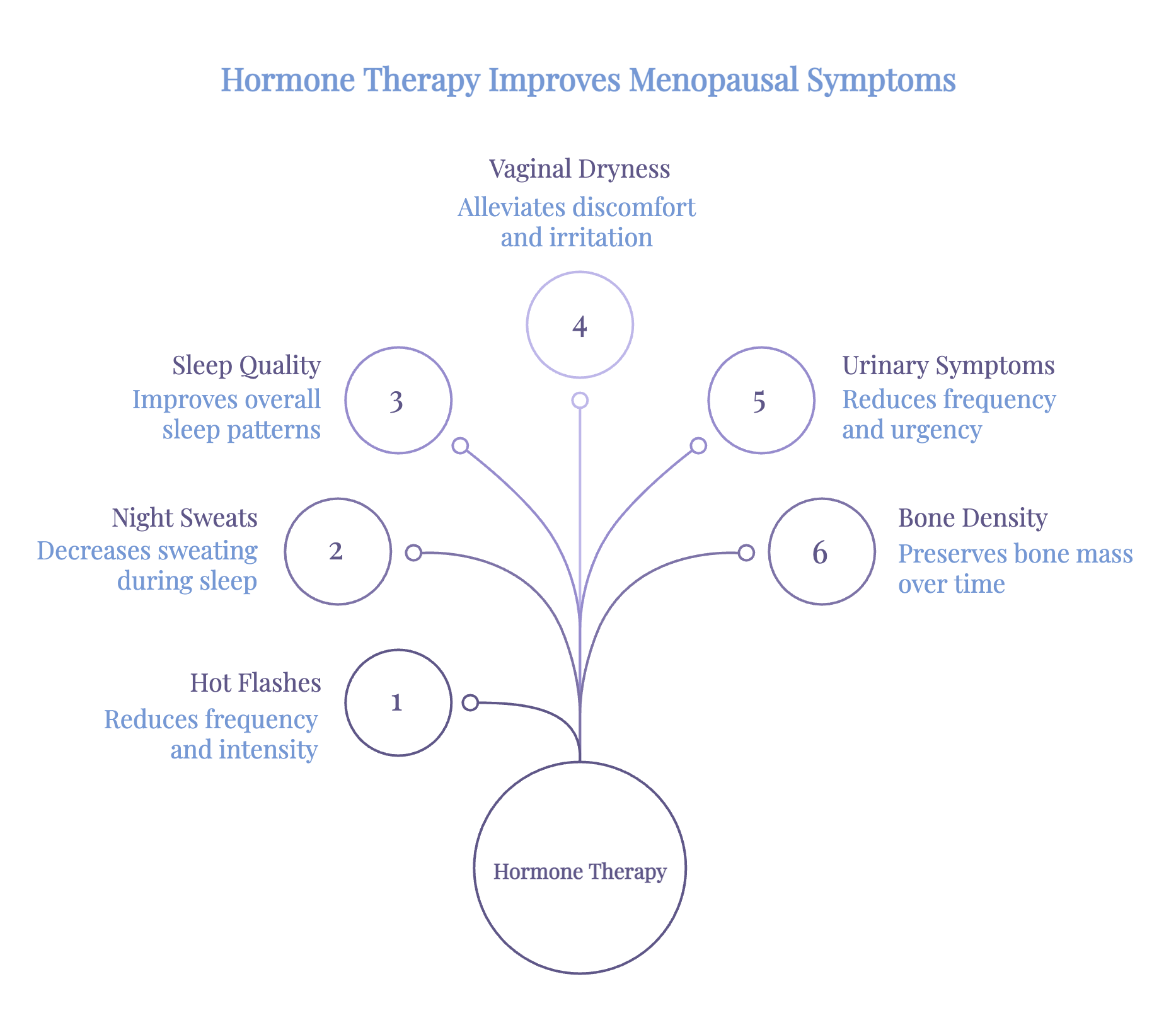
It is considered the gold standard treatment for hot flashes and night sweats and can also
improve sleep, vaginal dryness, urinary symptoms, and overall quality of life.
An added bonus? Estrogen also helps preserve bone density, which becomes increasingly
important as we age.
Not All Hormones Are Delivered the Same Way
When many women think of hormone therapy, they picture a pill.
However, estrogen can also be more safely delivered through the skin using patches, gels,
or creams.
This is important because transdermal (through-the-skin) estrogen bypasses the digestive
system and liver. As a result, it is associated with a lower risk of blood clots than oral
estrogen and is often the preferred option for many women.
In my practice, most women who use estrogen, use a patch or gel.
Why Do Some Women Need Progesterone?
If you still have a uterus, estrogen must be paired with progesterone.
Progesterone helps protect the lining of the uterus from becoming excessively thick,
reducing the risk of endometrial hyperplasia and uterine cancer.
Women who have had a hysterectomy may not require progesterone, depending on their
individual circumstances.
Let’s Talk About Breast Cancer Risk
This is usually the biggest concern I hear from patients.
The breast cancer conversation is often presented in a way that sounds frightening
because we hear relative risk statistics without enough context.
Let’s look at absolute risk instead.
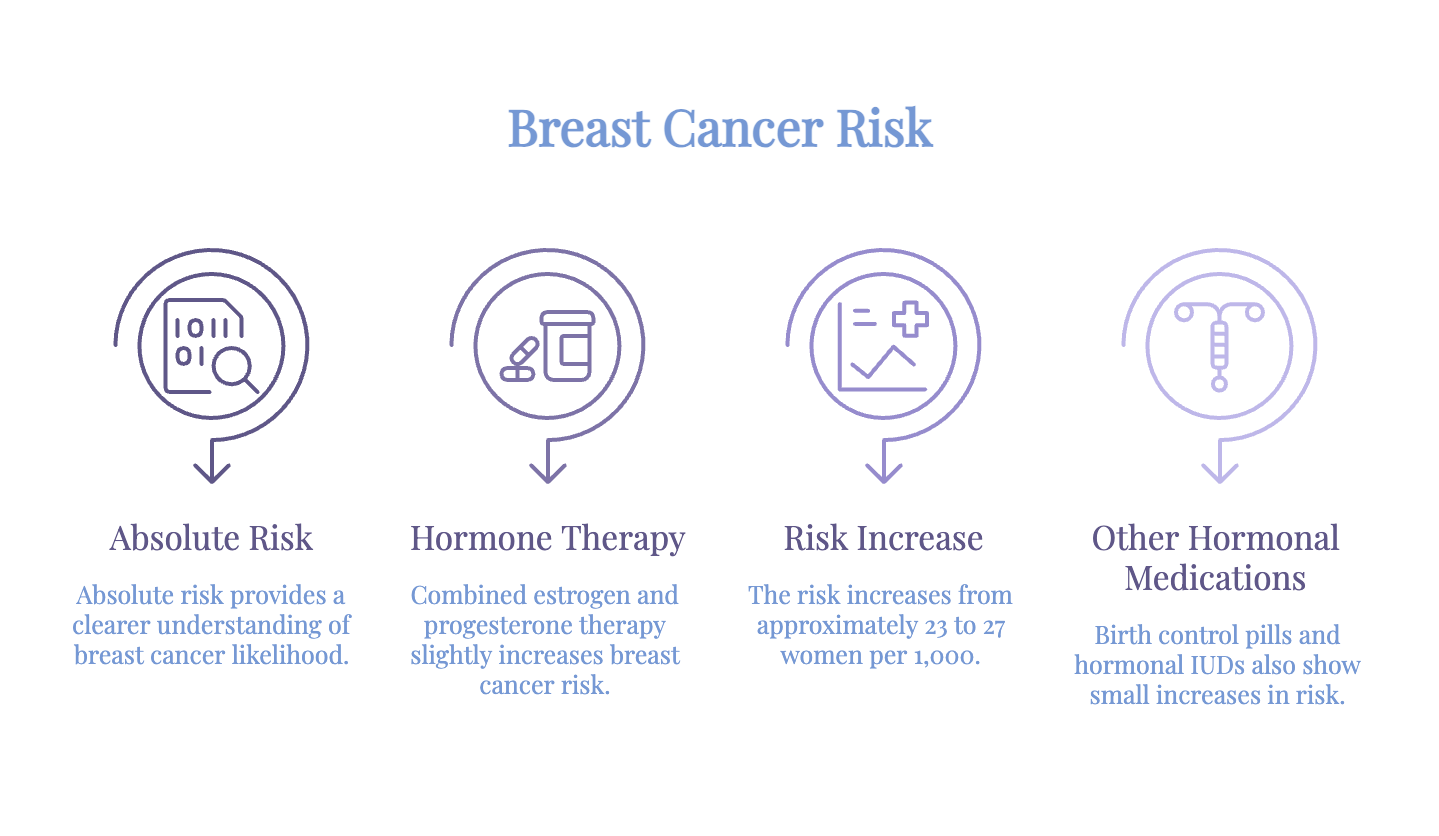
A large UK analysis found that among 1,000 women in their 50s who were not using
hormone therapy, approximately 23 would be expected to develop breast cancer over a
five-year period.
Among women using combined estrogen and progesterone therapy, there were
approximately 4 additional cases per 1,000 women over five years.
That means the risk increased from about 23 women per 1,000 to about 27 women per
1,000.
For some women, that increase feels acceptable when weighed against significant
symptom relief and improved quality of life. For others, it does not.
Neither decision is wrong.
It is also worth noting that small increases in breast cancer risk have been observed with
other hormonal medications as well, including birth control pills and hormonal IUDs.
This is not a concern unique to menopausal hormone therapy.
Is Hormone Therapy Right for Everyone?
No.
Like any medical treatment, hormone therapy has both benefits and risks.
Factors such as your age, family history, personal health history, cardiovascular risk
factors, and individual symptoms all play a role in determining whether hormone
therapy is appropriate for you.
This is why a personalized assessment is so important.
What If You Don’t Want Hormones?
Hormone therapy is not the only option.
Some women prefer to avoid hormones, while others have medical reasons that make
them unsuitable candidates.
Depending on your symptoms, alternatives may include:
- Lifestyle and nutrition strategies
- Exercise programs
- Stress-management techniques
- Cognitive behavioural therapy
- Non hormonal pharmaceuticals
- Evidence-informed natural health products (supplements, herbs, etc.)
These options can be very helpful for some women, although they generally do not
reduce hot flashes and night sweats as effectively as hormone therapy.
A Note About Prescribing in Ontario
Many women are surprised to learn that Ontario naturopathic doctors currently cannot
prescribe oral progesterone.
At the time of writing, I work collaboratively with a patient’s family physician or nurse
practitioner when oral progesterone is required as part of a hormone therapy plan.
Regulatory changes are currently being explored by the Ministry of Health, and
prescribing rights for oral progesterone are looking very promising for naturopathic
doctors in Ontario in the near future.
The Bottom Line
Menopausal hormone therapy is not right for every woman, but it is also not the
dangerous treatment many women were once led to believe.
For appropriately selected patients, it can be a safe and effective option that significantly
improves quality of life, sleep, comfort, and overall wellbeing.
If you’re struggling with menopausal symptoms, don’t assume you simply have to “push
through it.” There are options available, and together we can explore which approach
best fits your health history, goals, and comfort level.
References:
- National Health Service (NHS). Benefits and Risks of Hormone Replacement Therapy
(HRT). Available at: https://www.nhs.uk/medicines/hormone-replacement-therapy-hrt/benefits-and-risks-of-hormone-replacement-therapy-hrt/ - American College of Obstetricians and Gynecologists (ACOG). Hormonal Contraception
and Risk of Breast Cancer. 2018. Available at: https://www.acog.org/clinical/clinical-guidance/practice-advisory/articles/2018/01/hormonal-contraception-and-risk-of-breast-cancer - National Cancer Institute. Oral Contraceptives (Birth Control Pills) and Cancer Risk.
Available at: https://www.cancer.gov/about-cancer/causes-prevention/risk/hormones/oral-contraceptives-fact-sheet - Cancer Research UK. Does Hormone Replacement Therapy (HRT) Increase Cancer Risk?
Available at: https://www.cancerresearchuk.org/about-cancer/causes-of-cancer/hormones-and-cancer/does-hormone-replacement-therapy-increase-cancer-risk - The North American Menopause Society (NAMS). The 2022 Hormone Therapy Position
Statement of The North American Menopause Society. Menopause. 2022;29(7):767-794. - Canadian Menopause Society. Menopause Hormone Therapy Guidelines and Patient
Resources.