
It is 8:52 on a Tuesday morning. You are three sentences into explaining something you know inside out, and the word is gone.
Not a difficult word. An ordinary one. You talk around it, you land somewhere close enough, and the meeting moves on. Nobody noticed. You noticed. Your heart is going a little faster than it was thirty seconds ago and you are not entirely sure why.
By the end of August, most women have collected a season’s worth of these moments. The kitchen you walked into for no reason. The name of the woman you have known for a decade. The paragraph you have now read four times.
Here is what we want you to know before you read another word. There are two very different things that get called brain fog, they feel almost identical from the inside, and they respond to completely different interventions.
One is hormonal. Your brain is adapting to a fuel supply that keeps changing. The other is depletion, which is what happens when your sleep is fragmented, your ferritin is low, or your thyroid has quietly shifted. Most women in perimenopause have some of both, and almost nobody has been helped to work out which one is running the show.
That is why the crossword did not help. That is why the omega 3 made a small difference and then stopped.
In this article, you will learn how to tell the two kinds of fog apart, why late summer and the return to routine makes both worse at once, what genuinely restores clarity in each case, and when memory changes cross the line from frustrating into something that needs proper assessment.
Two Kinds of Fog Wearing the Same Cardigan
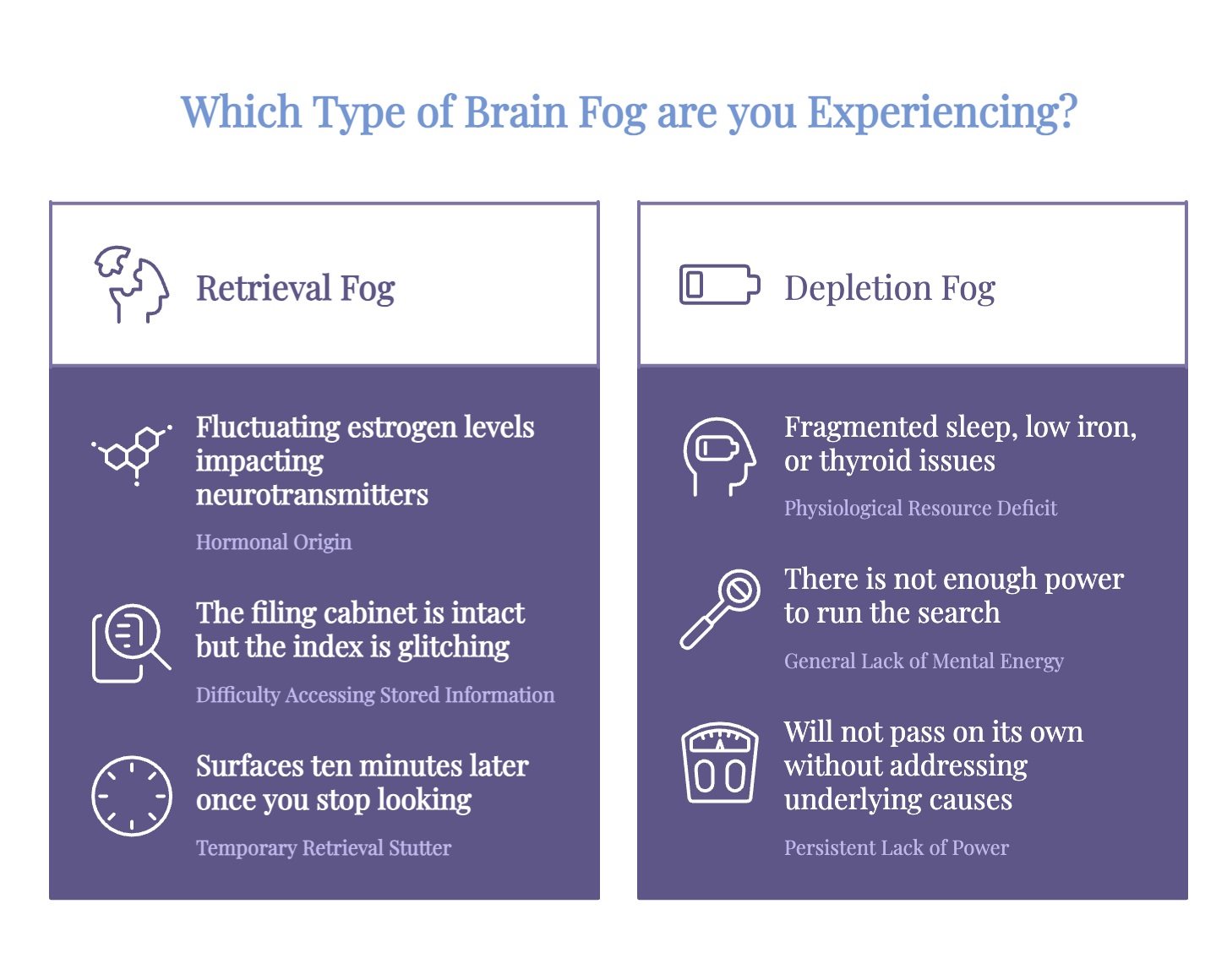
The retrieval fog is hormonal. The information is in there. You know the word, the name, the reason you came upstairs. It surfaces ten minutes later, unhelpfully, once you have stopped looking for it. This is the signature of fluctuating estrogen.
Estrogen receptors are concentrated in the hippocampus and prefrontal cortex, the regions handling memory formation, attention, and executive function. Estrogen affects how efficiently brain cells take up and use glucose, their main fuel, and it influences the neurotransmitters that carry the signal, including acetylcholine, which is central to learning and recall. When estrogen swings, the retrieval system stutters. The filing cabinet is intact. The index is glitching.
The depletion fog is different. It is not that you cannot find the word. It is that there is not enough power in the building to run the search. Everything is heavy. You reread things because nothing is going in. It is worse by mid afternoon and it does not lift with effort.
This kind is usually driven by fragmented sleep, low iron stores, an underactive thyroid, or blood sugar swings. It is not a hormone problem in the way most women assume, though hormonal change often creates the conditions for it by disturbing sleep and increasing menstrual blood loss.
This distinction matters enormously. If your fog is depletion and you treat it as inevitable hormonal change, you will spend three years waiting for something to pass that was never going to pass on its own.
How to Tell Which One You Have
Keep a note on your phone for two weeks. When the fog hits, record the time, what it felt like, how you slept, and where you are in your cycle if you are still cycling.
It is likely retrieval fog if:
- The word or name comes back later without effort
- It fluctuates. Some weeks are entirely fine
- It clusters in the days before your period
- You have other perimenopausal symptoms alongside it, such as disrupted sleep, mood changes, or cycle irregularity
- Your energy is reasonable but your recall is not
It is likely depletion fog if:
- It is steady rather than variable, present most days regardless of cycle timing
- It comes with real fatigue rather than just fuzziness
- It is worse in the afternoon, particularly after a light lunch
- You are also losing hair, feeling cold, or noticing breathlessness on stairs
- Sleep does not refresh you no matter how many hours you get
It is very often both. The two feed each other. Broken sleep worsens retrieval, and poor retrieval increases the mental effort of every task, which is exhausting. The point of sorting them is not to pick one. It is to know which one to address first.
Why Late Summer and September Make It Worse
August does not create the fog. It removes the conditions that were hiding it.
The mental load triples in three weeks. School supply lists, schedules, forms, camp ending, work returning to full speed after a slower July. Your prefrontal cortex is being asked to hold more open loops at once, at precisely the moment it is least equipped to do it. Fog is not a fixed quantity. It is the gap between what your brain can carry and what you are asking it to carry.
Summer sleep debt has accumulated. Late sunsets, warm nights, patio evenings, disrupted routine. If July fragmented your sleep, you arrive in September already running a cognitive deficit before the first day of school.
Alcohol has been more available than usual. Even moderate intake measurably disrupts the second half of the night, which is where a substantial amount of memory consolidation happens. A pleasant summer of two glasses on the deck has a cognitive cost that shows up as fog, not as a hangover.
Routine dissolved and took your meals with it. Skipped breakfasts, light lunches in the heat, eating at unpredictable times. Blood sugar instability is one of the most reliable producers of afternoon fog, and it is entirely fixable.
The light is changing. Sunset in Burlington moves earlier through August and September. Your circadian rhythm is adjusting, and the transition weeks are often the roughest for sleep quality and daytime alertness.
If It Is Retrieval Fog: Reduce the Load, Support the Brain
You cannot make estrogen stop fluctuating. You can absolutely change how much that fluctuation costs you.
- Externalize everything. Lists, calendars, alarms, a single capture place for every open loop. This is not giving in. It is freeing up working memory that is currently being spent holding things in place. Every item you write down is capacity returned to you.
- Do the hard thinking in your best window. Most women in this stage have a clear window, often mid morning. Protect it and put the demanding work there rather than answering email.
- Stop multitasking, particularly now. Task switching is expensive at the best of times and considerably more expensive when retrieval is impaired. Single tasking will feel slower and will actually be faster.
- Move your body. Exercise increases cerebral blood flow and supports brain derived neurotrophic factor, which is involved in learning and memory. Resistance training also protects the muscle and metabolic health that underpin the rest of this decade, which is part of why lifting weights changes everything in your 40s.
- Protect the second half of your night. Memory consolidation is not evenly distributed across the night, and the later hours matter. Night sweats, alcohol, and a warm bedroom all cost you exactly the sleep you need most.
- Consider whether hormone therapy belongs in your conversation. It is not prescribed as a cognitive treatment. For women with significant sleep disruption and vasomotor symptoms, restoring sleep often improves clarity substantially as a downstream effect. It is a reasonable thing to raise with a prescriber as part of a wider discussion.
If It Is Depletion Fog: Find the Thing That Is Missing
This is the half that responds fastest, and it is the half most often left uninvestigated.
- Ferritin, not just hemoglobin. Ferritin measures stored iron and falls long before anemia appears on a standard test. Low ferritin produces fatigue, poor concentration, hair shedding, restless legs, and breathlessness on exertion. If you have had heavy perimenopausal periods, this is very common and very correctable.
- A full thyroid panel, not a single number. Hypothyroidism causes slowed thinking, poor recall, and fatigue, and rates rise sharply in women over 40. TSH alone is a screening test rather than a complete assessment.
- Vitamin B12 and vitamin D. Both affect cognition and mood. Both are frequently low, particularly with age, acid reducing medication, plant based eating, or a Canadian winter approaching.
- Protein at breakfast. Roughly 30 grams. A palm sized portion of something substantial plus another source. Most women eat almost none in the morning and then wonder why the afternoon collapses. Steady blood sugar does more for daily clarity than any nootropic on the shelf.
- Screen for sleep apnea. This is consistently missed in women, because the presentation is often fatigue, insomnia, and morning headache rather than loud snoring. Risk rises substantially through and after the menopausal transition. No supplement treats sleep apnea.
- Look at your medications. Antihistamines, some blood pressure medications, and sleep aids all contribute.
What We Assess Before Reaching for Supplements
This is the part that gets skipped, and it is the part that changes outcomes.
There is a large market in products promising sharper thinking. Very little of it addresses why a specific woman’s brain is not working the way it used to. Before we build a plan, we want to know what is actually underneath.
That usually includes:
- Thyroid function assessed properly, including free T4, free T3, and antibodies rather than TSH alone
- Ferritin and full iron status, particularly with heavy or irregular bleeding
- Vitamin B12 and vitamin D
- Blood sugar and insulin markers, because the afternoon crash usually has a measurable cause
- Screening questions for sleep disordered breathing
- A careful history of the pattern, because cyclical fog and constant fog point in different directions
We use functional lab testing thoughtfully rather than exhaustively. The purpose is to know what we are treating, not to generate a long report.
Once we know, the plan becomes specific. That might mean iron repletion done properly, nutritional change, sleep work, herbal support, or a referral back to your family physician. Naturopathic care sits alongside conventional care here, not instead of it. What it should never mean is guessing.
When It Is Not Perimenopause
Most women searching for answers about memory in midlife are quietly asking a different question, and it deserves a straight answer rather than reassurance in general terms.
Perimenopausal fog fluctuates, involves retrieval rather than loss, and does not steadily progress. The patterns below are different, and they warrant prompt medical assessment:
- Memory loss that is clearly and consistently worsening over months
- Getting lost in familiar places or on routes you know well
- Difficulty performing tasks you have done for years, such as managing finances or following a familiar recipe
- Noticeable changes in personality or behaviour
- Confusion about time or place
- Family noticing before you did
Please have these assessed rather than monitored at home.
The Bottom Line
Retrieval fog and depletion fog feel the same on a Tuesday morning. They are not the same. One is your brain adapting to fluctuating estrogen. The other is your brain running without enough iron, thyroid hormone, sleep, or fuel.
Work out which one dominates. Externalize the load and protect your best window for the first. Get properly tested and fix what is missing for the second. Rebuild breakfast in both cases. And before you spend another season adding supplements to a question nobody has actually answered, get assessed.
You built a life that requires a working brain. Your capability has not left you. It is running on an unreliable supply during a transition that, for most women, does pass, and that responds far better to being understood than to being endured.
If your head has not felt like your own for a while, we would like to help. Book a perimenopause and menopause support consultation in Burlington and let us find out what is actually going on.
Frequently Asked Questions
Is brain fog a normal part of perimenopause?
Yes. Cognitive changes including word finding difficulty, forgetfulness, and reduced concentration are among the most commonly reported experiences of the perimenopausal transition, and they are linked to fluctuating estrogen and its effect on brain energy use and neurotransmitter activity. Research following women through the transition generally finds that cognitive performance recovers once hormone levels stabilize. Common does not mean nothing else is contributing, which is why testing is still worthwhile.
Why is my brain fog worse some weeks than others?
Because perimenopause is defined by hormonal variability rather than steady decline. Estrogen can swing high and then drop sharply within a single cycle, and many women notice fog clusters in the days before a period when the drop is steepest. If your fog is constant rather than cyclical, that points away from hormones and toward thyroid, iron, sleep, or blood sugar as the main driver.
Can something other than menopause cause brain fog in your 40s?
Yes, and this is worth taking seriously. Thyroid dysfunction, low ferritin, vitamin B12 deficiency, sleep apnea, depression, anxiety, and certain medications all produce identical symptoms. Please seek prompt assessment if memory loss is steadily worsening, if you are getting lost in familiar places, if you are struggling with tasks you have done for years, or if others have noticed changes in your personality or behaviour.
Looking for practical support with focus, energy, and hormones?
Explore our perimenopause and menopause support for women in Burlington, Oakville, Waterdown, and across Halton. This article is for educational purposes and is not a substitute for individualized medical advice. Please consult a qualified healthcare provider about your specific situation.