
The invitation arrives in June. A wedding, a cottage weekend, a beach day with friends you have known for twenty years. And somewhere between saying yes and finding something to wear, a quieter thought surfaces.
What happened to my body?
You have not changed how you eat. If anything, you eat less carefully now than you did at thirty five, and yet everything has moved. The weight sits around your middle where it never used to. The clothes that fit last summer do not. And the strategy that always worked, eating less and moving more, has stopped working entirely.
Most of the content you will find about this is designed to make you feel worse and then sell you something. Detoxes. Cleanses. Cortisol blockers. Thirty day resets. It is a very profitable industry built on a very specific vulnerability.
We are not going to do that.
What follows is an explanation of what actually changed in your body, why the old strategy backfires now, the four things that reliably help, and why this conversation matters far more for your heart and your bones than it does for your bathing suit.
What Actually Changed
Nothing about you failed. Four things shifted at once, and they compound.
Estrogen changed where fat is stored. Before perimenopause, estrogen favours fat storage in the hips and thighs, which is subcutaneous fat sitting under the skin. As estrogen declines, storage shifts toward the abdomen, and specifically toward visceral fat that surrounds the organs. Many women gain very little weight and still watch their waist change. The fat did not appear. It relocated.
Muscle mass declined quietly. From roughly age thirty onward, adults lose somewhere between three and eight percent of muscle mass per decade without a stimulus to maintain it. That loss accelerates through the menopausal transition, because estrogen supports muscle protein synthesis and satellite cell function. You have likely lost several pounds of muscle without ever noticing, because the number on the scale stayed flat while the composition underneath it changed.
Insulin sensitivity dropped. Muscle is where most of the glucose you eat is stored. Less muscle means fewer places to put it. Declining estrogen independently reduces insulin sensitivity as well. The same meal that was handled easily at thirty five now produces a higher and longer blood sugar rise, which favours fat storage, particularly visceral fat.
Your resting metabolic rate fell as a consequence, not as a mystery. Muscle is metabolically active tissue. Lose it, and your body burns less at rest. This is the entire explanation. It is not that your metabolism mysteriously broke at forty six. It is that you lost the tissue that drives it.
Add poor sleep, which raises ghrelin and lowers leptin so that hunger increases and fullness signalling weakens, and a stress load that keeps cortisol elevated, and the picture is complete.
None of this is a failure of discipline. It is endocrinology.

This Is a Heart Conversation, Not a Mirror Conversation
This is the part we most want you to hear.
Visceral fat is not cosmetic. It is metabolically active tissue that releases inflammatory signals and free fatty acids directly into the portal circulation feeding your liver. It is associated with insulin resistance, type 2 diabetes, and cardiovascular disease in a way that subcutaneous fat is not.
Meanwhile, estrogen loss changes your cardiovascular risk profile in its own right. LDL cholesterol and ApoB tend to rise. HDL function declines. Blood pressure often creeps upward. Bone loss accelerates sharply in the years immediately surrounding your final period, and muscle loss means fewer forces pulling on bone to maintain it, plus a higher risk of the fall that turns bone loss into a fracture.
Heart disease is the leading cause of death for Canadian women. It is not breast cancer, though most women assume it is.
So when we talk about your midsection, we are not talking about how you look in a swimsuit. We are talking about whether you will be strong at seventy. Whether you will hike, travel, lift your grandchildren, and stay in your own home. Good health creates opportunity, and that is the actual stake here.
The bathing suit is a real feeling and it deserves compassion. It is simply not the reason this matters.
Why Eating Less Backfires Now
The old formula was cut calories, add cardio, wait. Here is what that does to a perimenopausal body.
When you restrict calories aggressively without enough protein or a resistance training stimulus, a meaningful portion of the weight you lose is muscle. You have now made the underlying problem worse. Your resting metabolic rate falls further. Your insulin sensitivity worsens, because you have removed more of the tissue that stores glucose. Your bone density suffers.
You regain the weight eventually, as almost everyone does, and it returns as fat rather than as the muscle you lost. Each cycle leaves you with a less favourable body composition than the one before, at a lower resting metabolic rate, requiring even less food to maintain.
Meanwhile, prolonged energy restriction raises cortisol, disrupts sleep, and worsens the exact hormonal environment driving abdominal storage.
This is why women in their late forties often find themselves eating less than they ever have and getting nowhere. They are not doing it wrong. They are doing a strategy that is designed for a body they no longer have.
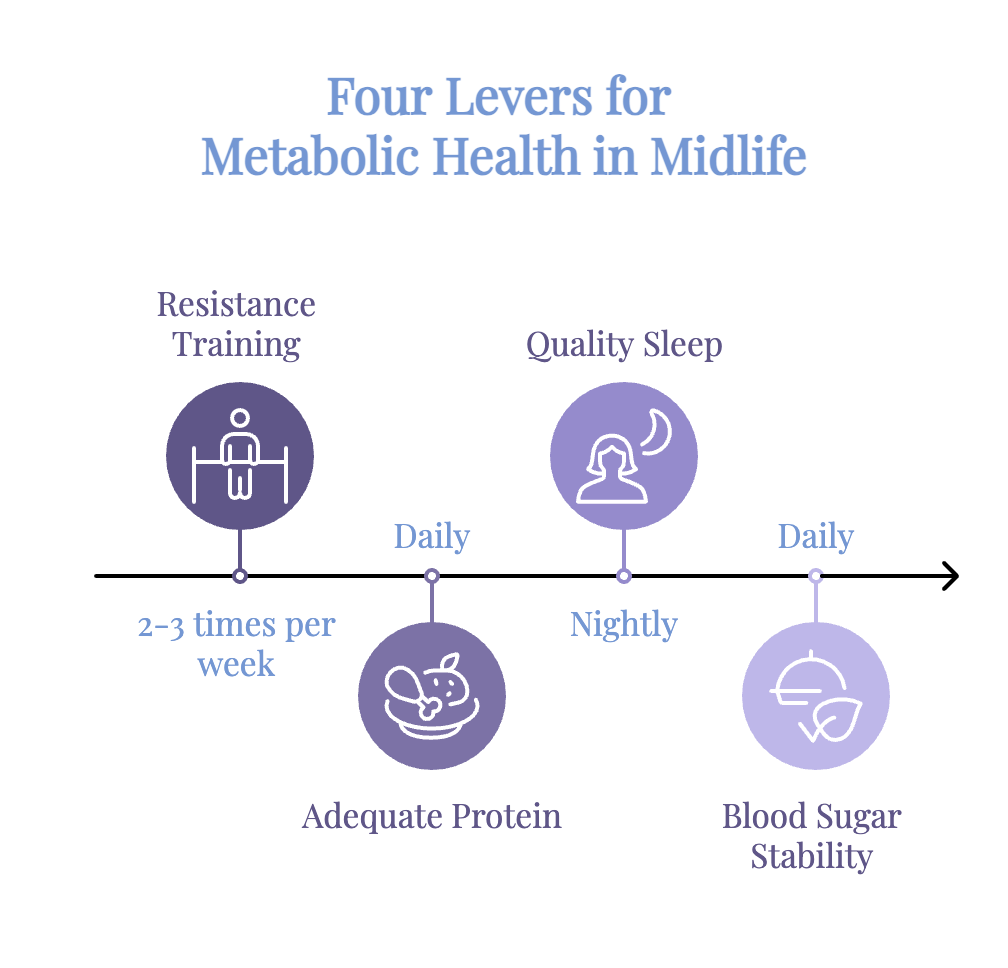
The Four Levers That Actually Work
1. Resistance training, two to three times per week, with real load.
This is not negotiable and it is not the light weights in the corner of the gym. Progressive resistance training is the only signal that tells your body to preserve and build muscle in the presence of declining estrogen. It improves insulin sensitivity, preserves bone density, supports resting metabolic rate, and reduces visceral fat independently of what the scale does.
Start with compound movements. Squats, hinges, presses, rows, and carries. Get coached if you can. Add weight over time. Six months of consistent lifting will change more than any dietary intervention available to you.
2. Adequate protein, distributed across the day.
Perimenopausal muscle is less responsive to protein than younger muscle, which means you need more of it, not less. Most research supports roughly 1.2 to 1.6 grams per kilogram of body weight per day for women in midlife, with something in the range of 25 to 35 grams at each meal rather than the typical Canadian pattern of a carbohydrate breakfast and one large protein serving at dinner.
For a 70 kilogram woman that is roughly 85 to 110 grams daily. Most women we assess are eating half that.
Protein also increases satiety and has a higher thermic effect than the other macronutrients, so it works in your favour on multiple fronts. Our nutrition and wellness resources can help you build meals around this rather than around restriction.
3. Sleep, treated as a metabolic intervention.
A week of short sleep measurably reduces insulin sensitivity, raises hunger hormones, increases cravings for high glycemic foods, and reduces the proportion of weight lost as fat rather than muscle. You cannot out train it and you cannot out eat it.
If night sweats or 3 a.m. wakeups are stealing your nights, that is a metabolic problem, not just an inconvenience. It is worth treating first.
4. Blood sugar stability, built into the ordinary day.
Not a restrictive diet. A structural one. Protein and fibre at every meal. Vegetables in volume. Whole food carbohydrates paired with protein and fat rather than eaten alone. A ten minute walk after dinner, which lowers post meal glucose meaningfully. Adequate fibre, which most women fall well short of.
Add aerobic activity you actually enjoy on top of this, not instead of it. Walking, cycling, swimming, trail running. It supports cardiovascular health, mood, and stress resilience, and it should sit alongside strength work rather than replace it.
What Doesn’t Work, and Why
We would rather be plain with you than sell you comfort.
- Detoxes and cleanses. Your liver and kidneys perform detoxification continuously and competently. What these protocols produce is short term water and glycogen loss, some muscle loss, and a return to baseline within weeks.
- Cortisol blocking supplements marketed for menopause belly. Cortisol is genuinely involved. A capsule does not address the sleep debt, chronic stress, and under recovery that are driving it.
- Chronic cardio alone. Hours of moderate cardio without resistance training can reduce weight while accelerating muscle loss, which worsens body composition over time.
- Fasting protocols applied indiscriminately. For some women they are useful. For many in perimenopause, extended fasting compresses the eating window so severely that protein intake becomes inadequate and cortisol rises. Context matters.
- Very low calorie diets. See the section above. They cost you the tissue you most need to keep.
Natural does not mean effective, and a supplement cannot replace a stimulus your muscles never received.
Measuring Progress Without a Scale
The scale is the least informative tool you own, because it cannot tell you what the weight is made of. Consider tracking:
- Waist circumference. The best simple proxy for visceral fat.
- Strength. What you lifted in January versus what you lift in July. This is progress you can feel.
- Bloodwork. Fasting glucose, HbA1c, lipids including ApoB, and inflammatory markers where indicated.
- Energy, mood, and sleep quality. Recorded honestly over weeks, not days.
- How you feel on the trail, the bike, or the stairs.
A woman who has lost two inches from her waist, added fifteen kilograms to her deadlift, and improved her HbA1c while the scale has not moved has succeeded completely. The scale simply cannot see it.
The Bottom Line
Your body changed because your hormones changed, not because you stopped trying. Estrogen decline shifted fat toward your abdomen, muscle mass fell, insulin sensitivity dropped, and your resting metabolic rate followed the muscle down.
Eating less makes it worse. Lifting heavy, eating enough protein, sleeping properly, and stabilizing your blood sugar make it better. And the reason to do any of it is not the wedding in July. It is your heart, your bones, your independence, and your capacity to keep saying yes to the things that make your life worth living.
We say this as a practice built by someone who trains, races, trail runs, and travels, and who believes that health is not the absence of illness. It is the capacity to fully engage with your life. You can read more about Dr. Lisa’s approach and background if that resonates.
You are allowed to want to feel good in your body. You are also allowed to want more than that.
If you are ready to stop fighting your body and start working with it, book a menopause and perimenopause consultation in Burlington. We will look at the whole picture, assess what needs assessing, and build a plan that respects your physiology and your goals.
Frequently Asked Questions
Why am I gaining weight around my middle when my diet hasn’t changed?
Declining estrogen shifts fat storage from the hips and thighs toward the abdomen, and specifically toward visceral fat around the organs. At the same time, muscle mass declines and insulin sensitivity drops, so the same food is handled differently. Many women see their waist change while the scale barely moves. This is a redistribution driven by hormones, not a change in your behaviour.
Will cutting more calories help me lose menopause belly fat?
Usually not, and it often makes things worse. Aggressive restriction without adequate protein and resistance training causes muscle loss, which lowers your resting metabolic rate and further reduces insulin sensitivity. The weight tends to return as fat. Building muscle and stabilizing blood sugar is a slower approach that produces durable change.
Is hormone therapy the answer to perimenopause weight gain?
Hormone therapy is highly effective for hot flashes, night sweats, and bone protection, and by improving sleep it can indirectly support body composition. It is not a weight loss treatment and should not be presented as one. Whether it is right for you depends on your symptoms, your medical history, and your preferences, which is a conversation worth having properly rather than deciding from a headline.
Wondering where to start? Explore our naturopathic services in Burlington, or read more of our health and wellness articles.
This article is for educational purposes and is not a substitute for individualized medical advice. Please consult a qualified healthcare provider about your specific situation