
Your cholesterol came back “fine” last year. Then a friend mentioned her doctor ordered an Lp(a) test, and now you are wondering what your own blood work might be missing. It is a fair question in midlife, when heart risk quietly shifts for women.
ApoB and Lp(a) testing looks past the standard lipid panel to two markers that can add useful detail about cardiovascular risk. Heart disease and stroke are the number one cause of premature death for women in Canada, so the details matter. In this post we explain what each test measures, why menopause changes the picture, what Canadian guidelines say, and how to bring these numbers into your next conversation about prevention.
What ApoB and Lp(a) Actually Measure
A standard lipid panel reports LDL, HDL, triglycerides and total cholesterol. ApoB is a protein that helps move cholesterol around your body, and measuring it gives a sense of how many potentially harmful particles are circulating. Lp(a) is a specific cholesterol-carrying particle whose level is largely set by your genes.
- ApoB: a count of the particles that can contribute to plaque, especially useful when triglycerides run high.
- Lp(a): an inherited particle that stays fairly stable through life, so one test is usually enough.
- LDL cholesterol: still important, but it can look reassuring while ApoB or Lp(a) tell a different story.

Why Menopause Changes Your Cholesterol Picture
Estrogen helps the body clear LDL particles from the blood. In the SWAN study, total cholesterol, LDL and ApoB rose noticeably in the year around the final menstrual period, while other risk factors changed more gradually.
Lipids are only one piece. Rising blood pressure in midlife often travels with these changes, as do the shifts in belly fat and blood sugar we describe in our post on midlife weight and metabolism.
Example: A 52-year-old woman whose LDL looks borderline might have an ApoB that sits higher than expected. That gap is a reason to look more closely at food, movement, sleep and family history, not a reason to panic.
What Canadian Guidelines Say About Testing
The 2021 Canadian Cardiovascular Society lipid guideline recommends measuring Lp(a) once in a lifetime as part of initial lipid screening. It also names ApoB or non-HDL cholesterol as a better guide than LDL when triglycerides are above 1.5 mmol/L.
- Lp(a) at or above 50 mg/dL (100 nmol/L) points to earlier, more focused risk-factor management.
- Women aged 40 and over, or postmenopausal, are among the groups listed for lipid screening.
- Since April 2026, Ontario’s lab schedule includes both ApoB and Lp(a) tests, linked to the 2021 guideline.
How We Use These Results in Burlington
Numbers mean the most in context. At our Burlington clinic, functional lab testing sits alongside your history, family background, blood pressure, sleep and stress so we can see the whole pattern.
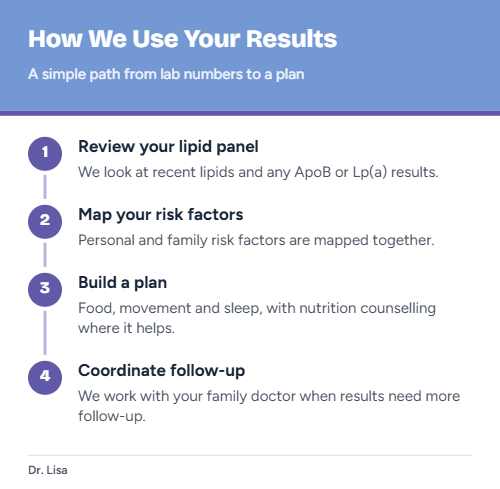
- Review your recent lipid panel and any ApoB or Lp(a) results.
- Map your personal and family risk factors together.
- Build a plan around food, movement and sleep, with nutrition counselling where it helps.
- Coordinate with your family doctor when results call for more follow-up.
The Bottom Line
ApoB and Lp(a) add depth to a cholesterol result, especially after menopause, when LDL and ApoB often rise. Lp(a) is mostly inherited, so a single test can tell you whether it belongs on your radar for life, while ApoB helps show how many risky particles are actually circulating. Neither number tells the whole story alone, and both are most useful alongside blood pressure, blood sugar, family history and daily habits. If you want a clearer view of your heart health in midlife, book your initial visit online, and talk to your ND about whether this is right for you.
Frequently Asked Questions
Do I need to fast before an ApoB or Lp(a) test?
Usually not. The 2021 Canadian guideline notes that Lp(a) is not influenced by fasting state, and non-fasting lipid testing is acceptable for most people. Your requisition may still ask you to fast if other tests are drawn at the same time, so check the instructions before your appointment.
If my Lp(a) is high, can lifestyle changes lower it?
Not by much. Lp(a) is more than 90 percent inherited and is not influenced by lifestyle factors, according to the 2021 Canadian guideline. That is why the focus shifts to everything you can change, such as blood pressure, ApoB, blood sugar, activity and smoking, to lower your overall cardiovascular risk.
Should my family members be tested if my Lp(a) is high?
It is worth raising with them. Because Lp(a) is largely genetic, a high result can run in families, and parents, siblings and adult children may share it. Each person can ask their own health care provider whether a once-in-a-lifetime Lp(a) test makes sense for them.