

You’ve always known your skin. You knew its tendencies, its rhythms, what it liked and what it didn’t.
And then, somewhere in your late 30s or early 40s, it changed.
More dryness than before. A dullness that doesn’t lift with moisturizer. Fine lines appearing faster than expected. Or, confusingly — breakouts, after years of clear skin. Or both at once.
You’re not imagining it. And it’s not “just aging.”
Your skin is responding directly to the hormonal shifts of perimenopause. And once you understand what’s driving these changes, you can actually address them at the source.
What Estrogen Does for Your Skin
Estrogen receptors are found throughout the skin — in the epidermis, the dermis, and the hair follicles. This means estrogen has a direct and significant effect on how your skin functions.
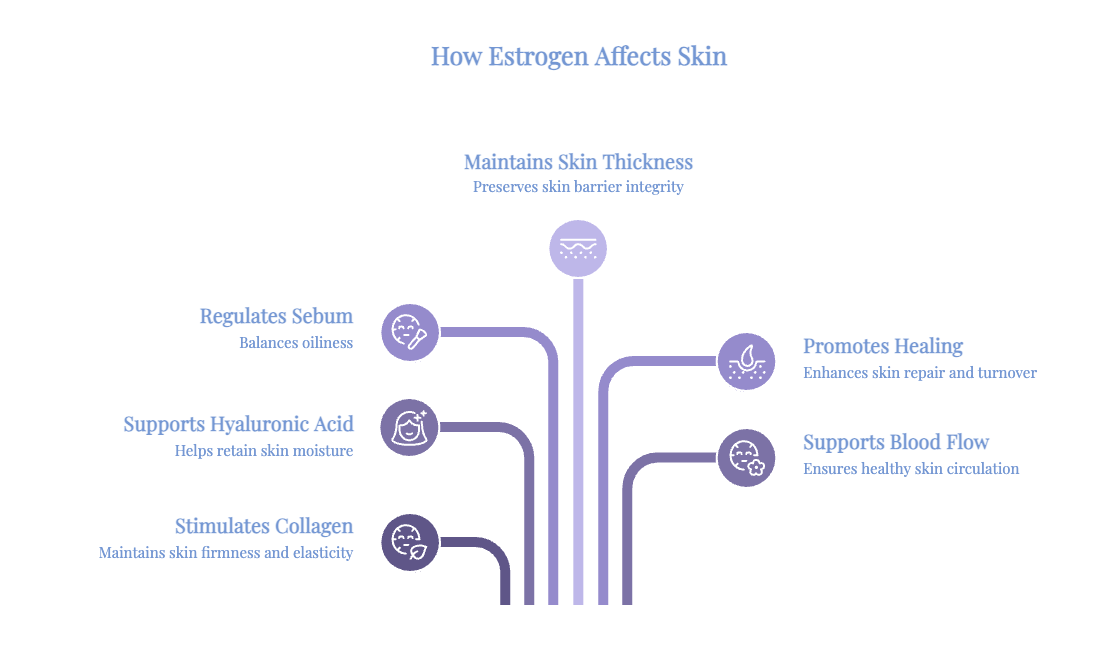
Estrogen:
• Stimulates collagen production — collagen is the structural protein that gives skin its firmness and elasticity
• Supports hyaluronic acid synthesis — the skin’s natural moisture-retention molecule
• Regulates sebum production — helping balance oiliness
• Maintains skin thickness and barrier integrity
• Promotes skin healing and cellular turnover
• Supports healthy blood flow to the skin
When estrogen begins to fluctuate — and eventually decline — all of these functions are affected. The skin doesn’t lie.
What Changes in Perimenopause
Collagen Loss
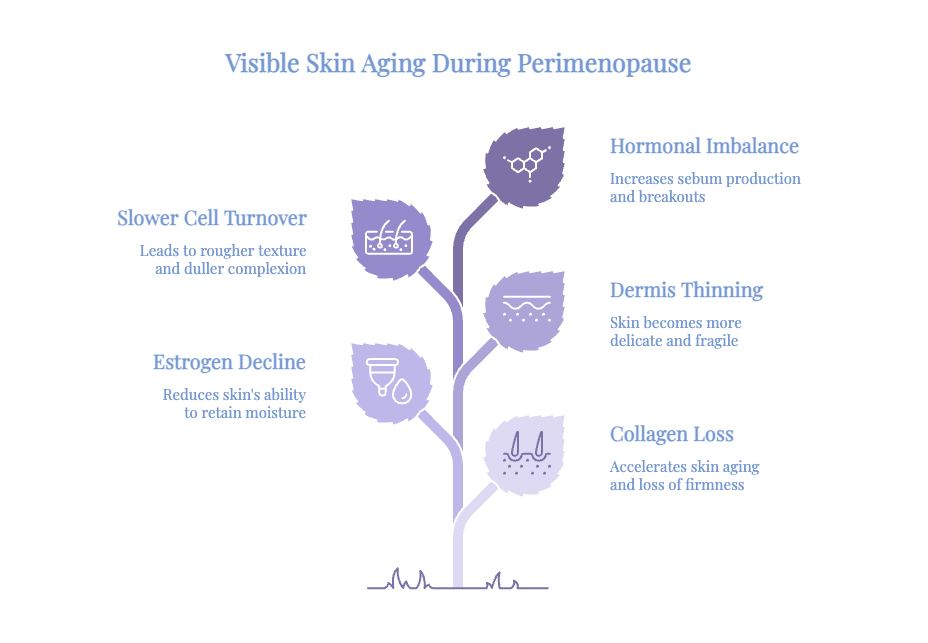
Collagen begins to decline from our mid-30s. But the rate of that decline accelerates significantly in perimenopause. Research suggests women can lose up to 30% of their skin’s collagen in the first five years of the menopausal transition — and this process begins before the final period.
The result: fine lines deepen, skin loses firmness, and the face may appear less “plump” than before.
Dryness and Loss of Glow
Estrogen stimulates hyaluronic acid — the molecule that holds water in skin tissue. As estrogen declines, the skin’s ability to retain moisture decreases. This shows up as dryness, tightness, and a dullness that topical moisturizers alone can’t fully correct.
Skin Thinning
Without adequate estrogen support, the dermis loses density over time. Skin may begin to feel more delicate, more fragile, or more transparent. Healing can take longer.
Texture Changes
Slower cell turnover — the process by which old skin cells shed and new ones surface — can lead to a rougher texture and duller complexion. The luminosity many women associate with younger skin is, in part, a reflection of faster cellular renewal.
Hormonal Breakouts
This one surprises a lot of women. As estrogen fluctuates, testosterone becomes relatively more dominant in the hormonal balance. Testosterone drives sebum production. More sebum means more clogged pores — particularly along the jaw and chin. You may experience hormonal breakouts in midlife that are entirely different in character from teenage acne.
The Gut-Skin-Hormone Connection
Skin health doesn’t start at the skin. It starts in the gut.
Your gut microbiome plays a direct role in how estrogen is metabolized and recirculated in the body — a system called the estrobolome. When the gut microbiome is imbalanced, estrogen metabolism is impaired. This can worsen hormonal fluctuations, increase systemic inflammation, and show up visibly in the skin.
Gut inflammation is a common driver of skin conditions — acne, redness, dryness, and sensitivity. This is why naturopathic skin care isn’t just about what you apply externally. It begins internally.
What Actually Helps
From the Inside
Protein and collagen-rich foods. Collagen synthesis requires amino acids. Prioritize protein at every meal — eggs, fish, meat, legumes. Glycine-rich foods (bone broth, skin-on poultry) are particularly relevant for collagen support.
Vitamin C. An essential cofactor for collagen synthesis. The body cannot make collagen without it. Found in citrus, bell peppers, strawberries, kiwi.
Omega-3 fatty acids. Support the skin barrier, reduce inflammation, and help maintain skin moisture. Found in fatty fish, flaxseed, walnuts.
Gut support. Probiotics, fermented foods, and fibre-rich vegetables support the estrobolome and reduce the gut inflammation that often surfaces in the skin.
Collagen peptides. Emerging clinical evidence supports their role in improving skin elasticity and hydration in midlife women.
On the Skin
Vitamin A (retinoids). The most evidence-backed anti-aging topical available. Stimulates cell turnover and collagen production. Start with a lower concentration and increase gradually.
Vitamin C serum. Supports collagen synthesis, brightens skin, and provides antioxidant protection against UV damage.
Hyaluronic acid. Most effective when applied to damp skin and sealed with a moisturizer. Draws water into the skin — but needs moisture present to do its job.
SPF — every single day. UV exposure is the primary accelerant of collagen breakdown. Not negotiable, regardless of season.
A Note on Hormonal Breakouts
If you’re experiencing adult acne in perimenopause, this is hormonally driven — not the same as teenage acne. Treating it with products designed for teenage, oil-prone skin can strip and irritate a perimenopausal complexion that is also dealing with dryness. Understanding the hormonal driver matters — and allows for more targeted, appropriate support.
The Bottom Line
The skin changes you’re noticing in your 40s are not inevitable consequences of aging. They are hormonal. Which means they are, to a meaningful degree, addressable.
The most effective approach combines internal support — nutrition, gut health, targeted supplementation — with evidence-informed topical care and a clear picture of what’s happening hormonally.
If you’re in Burlington and you want to understand what’s driving your skin changes and how to approach them from the inside out, book an appointment and we’ll look at the full picture together.
Simply Healthy. Simply Strong.
References
- Thornton MJ. Estrogen functions in skin and skin appendages. Expert Opin Ther Targets. 2005;9(3):617–629.
- Shah MG, Maibach HI. Estrogen and skin — an overview. Am J Clin Dermatol. 2001;2(3):143–150.
- Calleja-Agius J, Brincat MP. The effect of menopause on the skin and connective tissue. Gynecol Endocrinol. 2012;28(4):273–277.
- Stevenson S, Thornton J. Effect of estrogens on skin aging and the potential role of SERMs. Clin Interv Aging. 2007;2(3):283–297.
- de Miranda RB, et al. Effects of hydrolyzed collagen supplementation on skin aging. J Drugs Dermatol. 2021;20(9):1072–1076.
- Baker JM, et al. Estrogen-gut microbiome axis: physiological and clinical implications. Maturitas. 2017;103:45–53.