
You’re not stressed the way you used to be stressed.
It’s something else. A low hum that doesn’t switch off. Tired in a way that sleep doesn’t fully fix.
Running at full capacity — and yet feeling emptier than before.
Small things triggering bigger reactions. A sense of your nervous system being permanently
slightly on edge.
If you’re in perimenopause, there is a real physiological explanation for this. And it has
everything to do with how your stress system and your hormones are intersecting right now.
Your Stress Response Is Not the Same as It Was
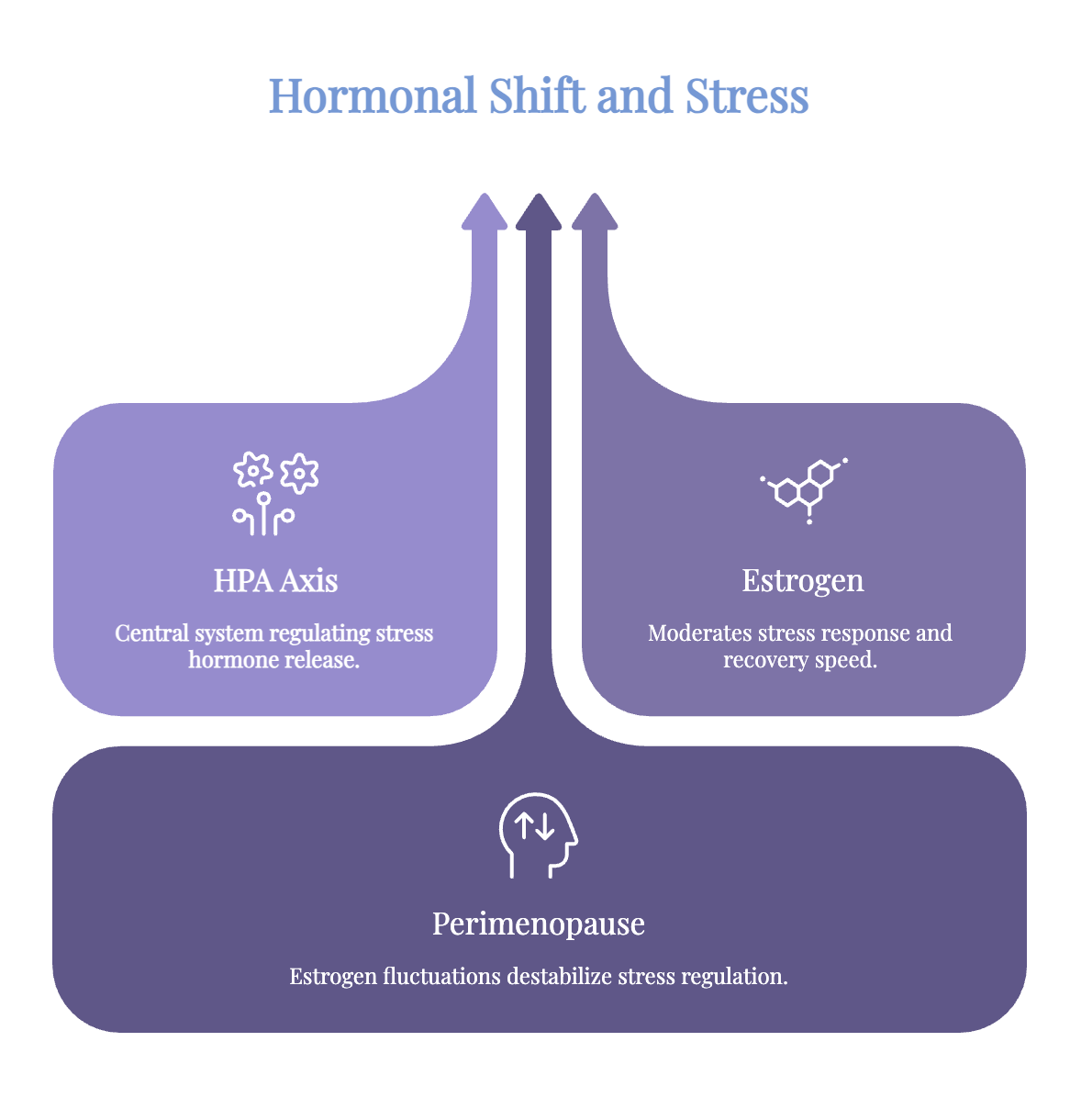
The HPA axis — the hypothalamic-pituitary-adrenal axis — is your body’s central stress
regulation system. When you encounter a stressor, the HPA axis coordinates the release of
cortisol, your primary stress hormone.
What most women don’t know:
Estrogen has a direct moderating effect on HPA axis activity.
Estrogen helps regulate how strongly the stress response fires — and how quickly it recovers.
As estrogen begins to fluctuate in perimenopause, that moderation becomes less stable.
The result:
- The stress response becomes more reactive
- Cortisol spikes become more pronounced
- Recovery from stress takes longer
- Stressors that you used to handle easily now feel amplified
You haven’t become less resilient. Your hormonal regulation of the stress system has changed.
There is a difference.
The Cortisol-Progesterone Loop
Here is where it gets particularly important.
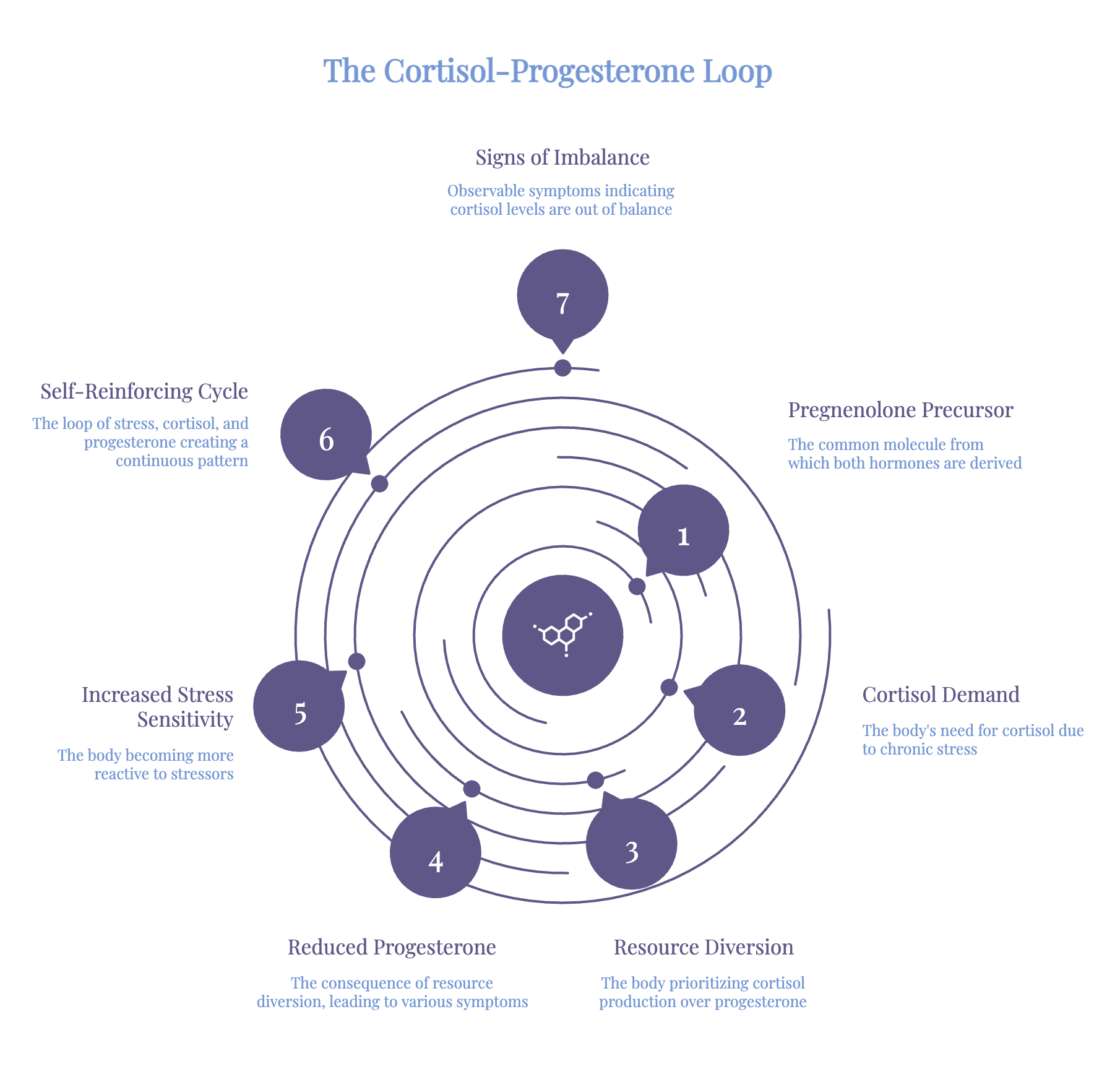
Cortisol and progesterone share a common precursor molecule called pregnenolone. When
stress is chronic and cortisol demand is high, the body can prioritize cortisol production —
diverting resources that would otherwise support progesterone synthesis.
Less progesterone means:
- More anxiety and nervous system reactivity
- More disrupted sleep — progesterone is naturally calming and supports deep sleep
- Greater emotional sensitivity
- A worsening of the very symptoms that make perimenopause feel so destabilizing
And here is the cycle: stress raises cortisol, cortisol competes with progesterone, lower
progesterone increases stress sensitivity, which raises cortisol further.
It is self-reinforcing. And it is not in your head.
Signs That Your Cortisol May Be Out of Balance
You may recognize some of these:
- Waking between 2–4AM with your mind already running
- Exhausted during the day, but unable to wind down at night
- Craving sugar, salt, or carbohydrates — particularly in the afternoon
- Feeling slow and foggy in the morning, then more alert as the evening approaches
- Anxiety or irritability that feels disproportionate to the situation
- Abdominal weight gain that doesn’t respond to changes in diet or exercise
- Catching every bug that goes around — immune resilience feeling lower than usual
These are not character flaws or signs of failure. They are physiological patterns — and they tell
us something specific about what’s happening in your nervous system.
Cortisol, Metabolism, and Weight
Chronically elevated cortisol has a direct and significant impact on metabolism:
- Drives visceral fat accumulation — particularly around the abdomen — regardless of diet
- Dysregulates blood sugar — raising glucose and promoting insulin resistance over time
- Breaks down muscle tissue — worsening the sarcopenia problem already amplified by
estrogen decline - Disrupts thyroid function — compounding fatigue and metabolic slowdown
This is not about willpower or effort. It’s about physiology.
When cortisol is chronically dysregulated, weight and metabolic changes become resistant to
conventional approaches — because the root driver isn’t being addressed.
What You Can Do About It
1. Protect Sleep Above Everything Else
Sleep is when the HPA axis resets. Disrupted sleep feeds the cortisol cycle — and the cortisol
cycle feeds disrupted sleep. Breaking this loop is often the highest-leverage intervention in the
whole picture.
2. Move Differently
Overtraining — particularly excessive high-intensity cardio — elevates cortisol further. Strength
training 2–3 times per week with adequate recovery is significantly more supportive of HPA axis
balance than daily high-intensity output.
Movement that is nourishing — walks in nature, yoga, gentle cycling — actively supports
nervous system recovery. Not as a substitute for structured exercise, but as part of a balanced
approach.
3. Stabilize Blood Sugar
Every blood sugar crash is a cortisol event. Protein at every meal, reducing refined sugars, not
going long stretches without eating — these reduce the glucose swings that chronically trigger
the stress response. Blood sugar stability and cortisol balance are inseparable.
4. Breathwork and Nervous System Regulation
This is not a luxury. Slow, extended exhalation breathing directly activates the parasympathetic
nervous system — your body’s “rest and recover” state — and measurably reduces cortisol.
Even five minutes of focused breathwork before bed shifts the autonomic nervous system in a
meaningful direction. It is one of the most accessible tools available. And it works.
5. Consider Adaptogenic Support
Adaptogenic herbs have a long history of use in supporting HPA axis resilience — and a
growing body of clinical evidence:
- Ashwagandha — well-researched for cortisol reduction and improved stress tolerance
- Rhodiola — supports mental performance and fatigue under stress
- Holy basil (tulsi) — a gentle adaptogen with anti-anxiety and cortisol-modulating
properties
What’s right for you is individual — adaptogen selection should be based on your specific
pattern, not a general recommendation.
6. Assess the Full Picture
Cortisol dysregulation doesn’t exist in isolation. Thyroid function, iron levels, hormonal status,
and nutrient deficiencies (particularly magnesium, B vitamins, and vitamin C) all interact with the
stress response. A comprehensive assessment helps identify what’s actually driving your
pattern — so the plan you build is the right one.
The Bottom Line
“Wired but tired” is not a personality type. It is a physiological state — one that has a name, a
mechanism, and a path forward.
Perimenopause changes how your body experiences and recovers from stress. That is not
weakness. That is biology.
And biology responds to the right support.
If this resonates and you’re ready to understand what’s driving your stress response in midlife,
book an appointment at my Burlington clinic and we’ll build a plan that works with your nervous
system — not against it.
Simply Healthy. Simply Strong.
References
- Handa RJ, et al. Estrogen receptor beta and the stress response. Front
Neuroendocrinol. 2012;33(2):134–147. - Altemus M, et al. Sex differences in anxiety and depression. Annu Rev Clin Psychol.
2014;10:19–40. - Genazzani AR, et al. Hypothalamic-pituitary-adrenal (HPA) axis and menopause.
Climacteric. 2007;10 Suppl 2:56–59. - Chandrasekhar K, et al. Efficacy and safety of ashwagandha root extract in reducing
stress and anxiety. Indian J Psychol Med. 2012;34(3):255–262. - Olsson EM, et al. A randomised double-blind placebo-controlled parallel-group study of
SHR-5 (rhodiola rosea). Planta Med. 2009;75(2):105–112. - Loucks AB, et al. Energy availability, not body fatness, regulates reproductive function in
women. Exerc Sport Sci Rev. 2003;31(3):144–148.