
It is 3:07 a.m. You are awake, again. The room is warm. The sheets are damp. Your mind has already started running through tomorrow’s list, and the harder you try to fall back asleep, the further away it gets.
By July, many women have stopped expecting anything different. Sleep has become something that happens to other people.
Here is what we want you to know before you read another word. Waking up drenched and waking up wired are not the same problem. They feel similar at 3 a.m. They have different causes, and they respond to completely different treatments.
Women spend months, sometimes years, treating one when they actually have the other. That is why the melatonin did not work. That is why the magnesium helped a little and then stopped.
In this article, you will learn how to tell the two apart, why a Southern Ontario summer makes both worse at the same time, what actually restores sleep in each case, and when it is time to have your sleep properly assessed rather than layering another supplement on top of an unanswered question.
Two Different Problems Wearing the Same Pyjamas
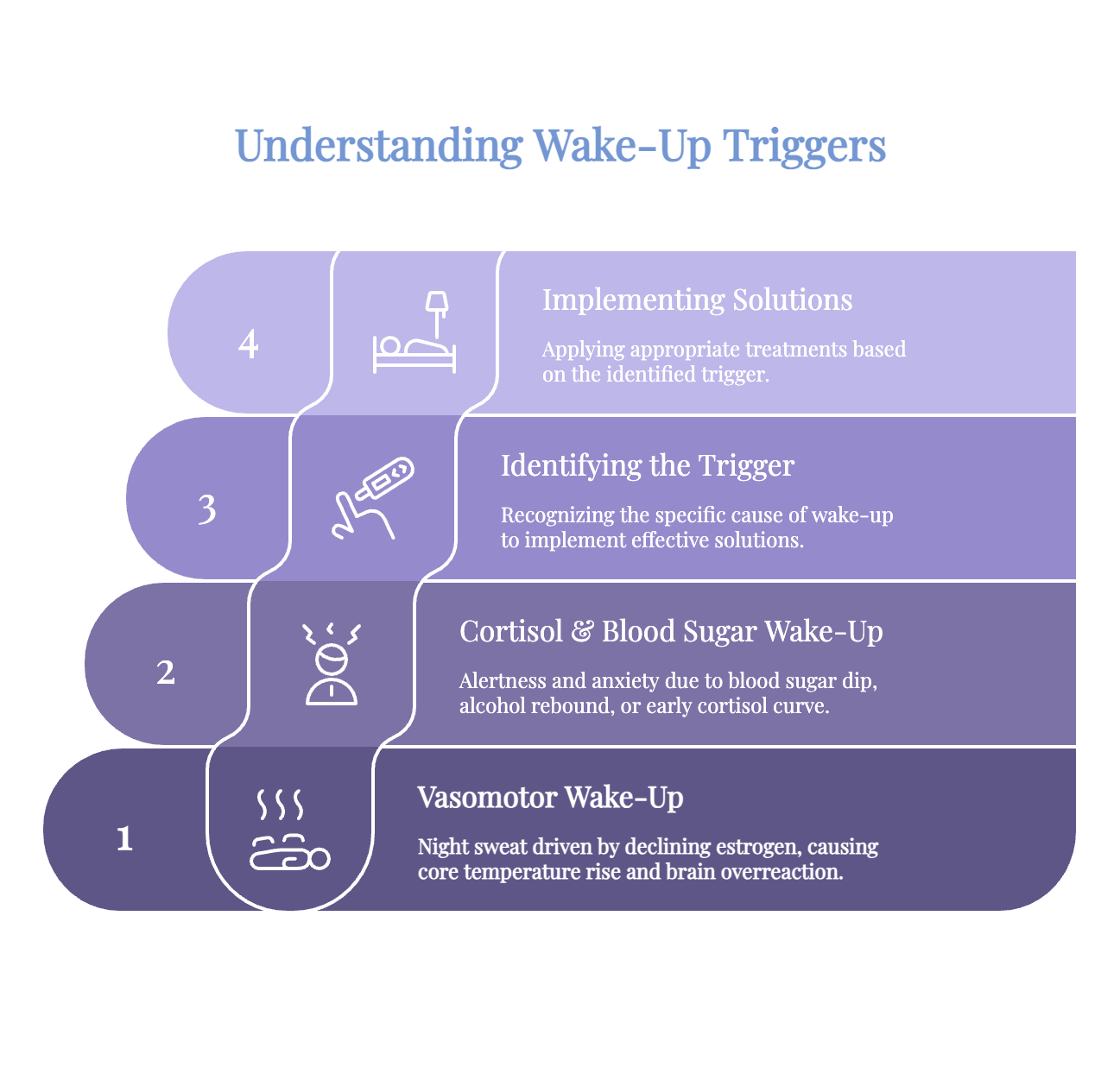
The vasomotor wake-up is a night sweat. It is the nighttime version of a hot flash, driven by the same narrowed thermoneutral zone that comes with declining estrogen. Your core temperature drifts up slightly, your brain overreacts, and you wake up flushed and sweating. The heat comes first. The waking comes second.
The cortisol and blood sugar wake-up is different. You wake up alert. Sometimes anxious. Sometimes with your heart beating a little fast. There may be no sweat at all, and if there is, it arrives after you are already awake rather than before. The waking comes first.
The second type is not a hormone problem in the way most women assume. It is usually a blood sugar dip, an alcohol rebound, or a cortisol curve that has drifted too early. Progesterone decline plays a role by removing some of its calming, sleep supporting effect, but the trigger is often metabolic rather than reproductive.
This matters enormously. If you are treating a cortisol wake-up with a cooling mattress topper, nothing will change. If you are treating a night sweat with evening protein, nothing will change.
How to Tell Which One You Have
Keep a simple log for two weeks. On waking, note the time and answer three questions. Was I hot before I woke? Was I anxious or alert? Did I drink alcohol, and how many hours before bed?
It is likely vasomotor if:
- Heat or a flush preceded the waking
- Your sleepwear or sheets are damp
- The wake-ups scatter across the night rather than clustering
- Cooling the room reliably reduces how often it happens
- You also have daytime hot flashes
It is likely cortisol or blood sugar if:
- You wake alert or anxious rather than hot
- The timing is consistent, often between 2 and 4 a.m.
- Your heart feels like it is racing slightly
- It is worse on nights you skipped dinner, ate very lightly, or drank alcohol
- You feel groggy in the morning but wired at night
It may well be both. Most women in perimenopause have some of each, which is exactly why single ingredient solutions disappoint. The goal is to identify which one dominates and address that first.
Why a Southern Ontario Summer Makes Both Worse
July does not create these problems. It removes every buffer you had.
Humidity blocks your cooling system. Sweating only lowers your temperature when the sweat evaporates. On a humid night in Burlington, with the dew point sitting high, the sweat stays on your skin and your body keeps trying. You get soaked without getting cool, so the sweating continues.
Overnight lows stay high. Your core temperature is meant to drop by roughly one degree in the hours before and during early sleep. That drop is one of the primary signals that initiates sleep. When your bedroom does not cool down, the signal is muted.
The sun sets after 9 p.m. Late evening light suppresses melatonin release and pushes your circadian rhythm later. You go to bed at your usual time with a body clock that thinks it is earlier, so you fall asleep lightly and wake more easily in the second half of the night.
Summer social life runs on alcohol. Wine on the patio, drinks at the cottage, a beer after a long ride. Alcohol is sedating at first, which is why it feels helpful. Then, as your body metabolizes it, you get a rebound: suppressed REM sleep in the first half of the night followed by fragmented, shallow sleep in the second half. The classic 3 a.m. wake-up after two glasses of wine is not a coincidence. It is pharmacology.
Routines dissolve. Later dinners, skipped meals in the heat, more caffeine, travel, guests, kids at home. Every one of these destabilizes blood sugar overnight.

If It’s Vasomotor: Cool the Room and the Body
The target is your core temperature, not your comfort.
- Bedroom temperature between 16 and 19 degrees Celsius. This is colder than most people set it and it is the single most effective change.
- Humidity between 40 and 50 percent. In a Southern Ontario July, this usually requires a dehumidifier, not just air conditioning. Lowering humidity often does more for night sweats than lowering temperature.
- Moving air. A fan aids evaporation. Air conditioning without airflow is less effective on humid nights.
- A cool shower before bed. Counterintuitively, this triggers a rebound drop in core temperature about an hour later, right when you want it.
- Breathable natural fibres. Bamboo, linen, merino, and cotton. Layered bedding so you can shed rather than fully wake to adjust.
- Alcohol within four hours of bed is a direct trigger. It dilates blood vessels and raises skin temperature at the exact moment you need heat to leave your core.
For persistent night sweats, acupuncture has been studied for vasomotor symptoms and is often useful for women who cannot or prefer not to use hormone therapy. It also tends to help the stress layer at the same time. You can read more about how we use acupuncture in Burlington as part of a broader plan.
If It’s Cortisol and Blood Sugar: Feed the Night
Your brain runs on glucose all night. If your blood sugar dips too low in the early hours, your body releases adrenaline and cortisol to raise it. Those hormones wake you up. Reliably. Around 3 a.m.
What helps:
- Adequate protein at dinner. Roughly 30 grams. In practice that is a palm sized portion of fish, chicken, tofu, or legumes plus something else. Many women in perimenopause are eating far less than they think, especially in summer when appetite drops in the heat.
- Do not skip dinner because it is hot. A salad with no protein is a recipe for a 3 a.m. wake-up.
- A small evening snack if you wake consistently. Protein and fat rather than carbohydrate alone. A spoonful of nut butter, a boiled egg, or plain Greek yogurt.
- Fibre with every meal. It slows glucose release and flattens the overnight curve.
- Alcohol, moved earlier or reduced. Even one drink measurably fragments the second half of your night. Try one week without it and compare your log. The result is usually persuasive.
- Address the stress load, not just the symptom. A cortisol curve that has drifted forward is often a nervous system that has been running hot for years. Breathing practices, boundaries, and genuine downtime are treatment, not indulgence. Our post on what lobsters can teach us about stress reframes this in a way many patients find useful.
Light, Timing, and the 9 P.M. Sunset
Your circadian rhythm is set primarily by light, and summer light is abundant and late.
- Get bright light in your eyes within an hour of waking. Ten to twenty minutes outdoors. This anchors your body clock and, in turn, sets your melatonin release for that night. It is the highest leverage sleep intervention that happens nowhere near bedtime.
- Dim your indoor lights after sunset. Lamps rather than overheads. Screens dimmed, or off entirely, in the final hour.
- Use blackout curtains. Southern Ontario sunrise in July is before 6 a.m. Light leaking into your room at 5:30 makes an early wake-up far more likely to stick.
- Keep wake time consistent, even on weekends. Your wake time anchors the entire rhythm. Bedtime can flex. Wake time should not.
What We Assess Before Reaching for Supplements
This is the part that gets skipped, and it is the part that matters most.
Supplements cannot fix a problem they were never designed to address. Before we build a sleep plan, we want to know what is actually going on underneath.
That commonly includes:
- Thyroid function, assessed properly rather than with a single number. Thyroid dysfunction mimics both night sweats and insomnia.
- Ferritin and iron status. Low iron stores are common in perimenopause, particularly with heavy or irregular bleeding, and low ferritin drives restless legs and fragmented sleep.
- Blood sugar and insulin markers, to see whether the overnight dip has a measurable cause.
- Screening for sleep apnea. This is critical and consistently missed in women. Postmenopausal women have a substantially increased risk, and the presentation is often fatigue, insomnia, and morning headache rather than loud snoring. No amount of magnesium will treat sleep apnea.
- Vitamin D, B12, and magnesium status, where clinically indicated.
- The pattern of your cortisol across the day, when the history suggests it.
We use testing thoughtfully, not excessively. The purpose is to know what we are treating, not to generate a long report.
Once we know, treatment becomes specific. That might mean herbal medicine, nutritional change, acupuncture, or a referral. It might mean a conversation with a prescriber about hormone therapy, which improves sleep substantially for many women whose disruption is genuinely vasomotor. What it should never mean is guessing.
The Bottom Line
Night sweats and 3 a.m. wakeups feel the same at 3 a.m. They are not the same. One is a temperature regulation problem. The other is usually a blood sugar, alcohol, or cortisol problem.
Figure out which one dominates. Cool the room and lower the humidity for the first. Feed the night, look hard at alcohol, and address the stress load for the second. Anchor your body clock with morning light. And before you spend another season adding supplements to a problem nobody has actually diagnosed, get assessed properly.
You are not meant to spend your summer exhausted. Sleep is not a luxury sitting at the bottom of your list. It is the foundation underneath your energy, your mood, your metabolism, and your capacity to enjoy the life you have built.
If your nights have not been your own for a while, we would like to help. Book a menopause and perimenopause support consultation in Burlington and let’s find out what is actually waking you up.
Frequently Asked Questions
Why do I always wake up at exactly 3 a.m.?
The consistency is the clue. A predictable wake-up time usually points to a metabolic or hormonal rhythm rather than a random disturbance. In the early morning hours your blood sugar reaches its lowest point and your cortisol begins its natural rise. If the dip is steep, adrenaline and cortisol are released to correct it, and that wakes you. Alcohol, skipped dinners, and low protein intake all deepen the dip.
Will melatonin help my menopause insomnia?
Sometimes, but less often than people hope. Melatonin is a timing signal, not a sedative. It helps when your body clock has drifted later, which is common in summer. It does nothing for night sweats, blood sugar dips, or sleep apnea. If melatonin has not worked for you, that is useful information rather than a failure. It suggests the cause lies elsewhere.
Can night sweats and insomnia be caused by something other than menopause?
Yes, and this is worth taking seriously. Thyroid conditions, low iron, sleep apnea, certain medications, anxiety disorders, and less commonly some infections and cancers can all present this way. Please seek prompt assessment if night sweats come with fever, unintended weight loss, lumps, unusual bruising, or bleeding after twelve months without a period.
Looking for practical nutrition and lifestyle guidance to support your sleep?
Explore our nutrition and wellness resources and our full range of naturopathic services in Burlington.
This article is for educational purposes and is not a substitute for individualized medical advice. Please consult a qualified healthcare provider about your specific situation.